Thursday, September 14, 2006

Americans Are Bad

Today, the school gave me a bicycle. Again. Actually, it's the same one given to me at the end of last semester to finally replace the one that was stolen, but this term I was told I couldn't have that one for reasons unknown, waited for the new one for two or three weeks, and was finally just given the same one again. Chinese people find it amusing that we only ride bikes for recreation in America, especially when I describe loading bikes onto a car, driving the car to a park, and then riding them. Even in a city as small as Zhangye, riding a bike is not relaxing: I have to be aware at every moment in order to dodge the various pedestrians, bikes, motorcycles, cars, donkeys, and carts of fruit that block my way. But it's still about the only exercise I enjoy, and I can venture farther into town and break the monotony of the area outside the university.

This evening I decided to branch out and eat at a restaurant I'd never been to in a different part of town. The staff at restaurants here are often less than subtle about their surprise at seeing a new foreign customer, and about halfway through the meal I could hear the server excitedly re-telling the entirety of our dialogue when I ordered to the rest of the staff, emphasizing the part when he asked "big or small?" in English. The Chinese are the anti-French in that they don't speak English but they love to use it.

Because I'm not out-going enough and I have trouble making small talk in any language, I don't get nearly as much conversation practice in Chinese as I should. Zhangye is lacking in things like teahouses, but outside the Great Buddha Temple is a shady walking street with benches, and occasionally I study Chinese there as conspicuously as possible in the hopes someone will come up to me to talk. Tonight I had one success, as a middle-aged man rode up on his bicycle to start a conversation. He immediately pulled out a soiled packet of "Sweet n'Low" sugar, all in English, which he proudly placed in my hands. In fact, I had trouble getting the (limited) conversation off the subject of the sugar, and he kept repeating a single, urgent question, which to me meant only "sugar youbing?". He was obviously convinced I would suddenly understand the words if he just tried hard enough, and he recruited a man riding a bicycle-powered garbage cart that passed by. I asked him to write his question, but he said only "my writing is not good" with some embarrassment and it became obvious that neither of them knew how to write. After the two had an extensive conversation about whether or not I could understand Chinese, rather than actually talking to me (this is common), Cart Man asked where I was from, and declared "Americans are bad!" as he rode away. I've heard little anti-American sentiment, but I'm sure that has as much to do with my limited Chinese as the open-mindedness of locals. In the end Sugar Man still didn't give up - he asked me to come again tomorrow, when he'll have someone else write out the question for him.
(note - he wasn't there but I later figured out he was asking if we have "diabetes" in America)

Tuesday, September 12, 2006

Some Boys Like to Collect Girls' Underwear

Learning Chinese is best undertaken by masochists. The spoken language has four tones, which must be pronounced clearly and accurately to be understand and to distinguish the many similar-sounding words (the sound shi can mean "to be", "ten", "time", "city", "to try", "an event", "lion", "wet", "teacher", "lose", "reality", "knowledge", "stone", "food", "arrow", "style", "the world", and many other things depending on context and pronounciation). It's the only major world language with no alphabet, and thousands of characters must be memorized before you can start reading and understanding Chinese. Mastering a word in spoken Chinese tells you nothing about how to write it, and there's no way to be certain of how to pronounce a character you've never seen before. Spoken and written Chinese are separate enough that it's like learning two difficult languages, and experts describe Chinese as around five times as difficult to learn as Spanish. Local dialects are so varied that Chinese people can find communication with people from other areas difficult. That said, I came here for a challenge, and I enjoy the punishment. I'm trying to re-double my efforts after losing ground while traveling, especially when I have trouble being understood and my Chinese teacher says things like "I see your listening hasn't improved over the summer."

Of course, learning English is no simple task for Chinese people, and all of them have to do it. They have the most difficult time doing it, as the total lack of grammatically correct English in public in China goes to show; even a large, fancy, and surely expensive hospital sign set in stone in Zhangye says "Zhangye city mumicipality." I could probably count the number of absolutely perfect English sentences my students have written on one hand. This week some students went over an old reading final exam with me, and some multiple-choice questions had either no right answer or several. Sometimes I have a very frustrating time getting my students not to speak Chinese when doing big groups activities, so I'll have to keep with smaller groups. One of these small group activities this week required students to answer the question "what is the strangest hobby you have heard of?". Many involved eating something, whether it was glass, soil, stones, or centipedes. A couple described things that would include my family - having a snake for a pet and enjoying fishing even if you don't catch anything. One shy boy stood up and said "I have heard that some boys like to collect girls' underwear."

My first few days back in Zhangye after traveling felt strangely underwhelming, but I knew once the teaching started my enthusiasm would pick back up. All in all I consider my students some of the most wonderful people I've met, and I enjoy things like office hours that ought to dreaded as "work." Usually an ideal group of only 4-10 people show up for my office hours, and last week's were particularly good, as a few students vented intelligently about some problems with Chinese teaching methods (namely, 'memorize and be quiet') being used for language and their appreciation of what the foreign teachers do. One of my favorite students wanted to ask if I knew about an English book she had heard about, that she wanted to look into because the main character was a rebel and older Chinese critics warned against it. She didn't know the English title, but she said the author's Chinese name was something like "Sha Lin Jia", and I immediately perked up and asked "do you mean Salinger??". She indeed meant The Catcher in the Rye, so I let her borrow the copy I brought, which made my day.

There is a holiday in China called Teacher's Day, which happened last Sunday. In America those kinds of holidays tend to get marked on a calendar somewhere and never brought up, but this one seems important in China. A few students stopped by to see me and give me fruit, and many called to wish me a happy Teacher's Day. Both of my new classes gave me nice gifts - a stylish thermos, and by far the most entertaining, a toy guitar that lights up and plays children's songs when you touch it. The English department also had an extravagant hot pot dinner for all its teachers, in which the foreigners were placed together in the same room and the few Chinese teachers joining us said little. There was also the expected 30-course banquet for welcoming the new teachers (an older couple from New Zealand via Northern Ireland and a young Peace Corps volunteer) a mere two days later.

Finally, there was another performance with the "Guitar Club" Saturday evening, which was mentioned to me in a phone call three hours beforehand. Luckily two student friends happened to be in my apartment, and Xiao Ma's garbled Chinese was translated to me. This was at the Zhangye Medical College, a few of whose students I have met through the teacher Julian last term. Being nursing rather than English majors, they made my students sound like members of the House of Lords. Perhaps because they get less entertainment than Hexi (not that it's exactly a non-stop party here) they were so enthusiastic as to give the impression Chinese people do like rock music. I was told to play a song on my own towards the end, and Xiao Ma felt the need to summon an English-speaking teacher on stage to talk to me. She started with ni hao (hello), so I said ni hao in return, which was all it took to excite the crowd. She said in English, "your Chinese is very good!", and as I haven't let learned "don't patronize me" in Chinese, I only replied "I think it's just ok." I was asked to tell the audience about myself, and had to ignore Xiao Ma's scolding in my right ear about not saying it in English; I'm here as a teacher, not a novelty act. Though I've matured well past the point of enjoying guitar heroics, after so many performances of strumming on a barely-audible acoustic to songs that are absolutely boring for me to play, combined with many listless hours among a group I can't communicate well with, I felt a patriotic duty to show them how we play in America, and pulled out every obnoxious rock star behind-the-head-as-fast-as-possible-show-off move I could remember. This went over well, and someone shouted something like "one more song, how about it!", so I played and sang the one White Stripes song I know the words to, which received noticeably less enthusiastic applause. The quest to find an English singer has begun in earnest.

Saturday, September 02, 2006

Love Doctors and Big Buddhas

The second term of teaching at Hexi has begun, and I've picked up where I left off here. Zhangye feels pretty normal, but going back to America might blow my mind. Six of my eight classes are returning from last term, so it's a relief to see familiar faces who don't have to warm up to me for several weeks before they want to talk. I can end up in a half-hour conversation with some of my more talkative students when I run into them. It's nice to teach at a university. The first week I've eased the students into talking English again with an "advice column" lesson I found on the internet, including getting them into mock therapy groups in an activity called "Love Doctor." Some students have taken this chance to ask me about my personal life and offer advice, which has been amusing: "what are your problems? We are all doctors here."

I haven't properly returned to Zhangye until Xiao Ma has vaguely mentioned us playing at the school the next day, and I end up performing with the band in front of 500 students, which is what happened on Thursday. It was an entertainment extravaganza for the new freshman, so we just started it off with two songs. The highlight was surely the student who sang Italian opera, and was amazing. Andrew told me he saw the large stage being set up on the basketball court and thought "ah, Dan will surely be playing on that." Despite becoming more Chinese than many Chinese-Americans he also says he's not sure about getting another job in China after going home for the summer and re-discovering that there are countries where things work properly and bathrooms are cleaned. I wonder what going home will do to me.

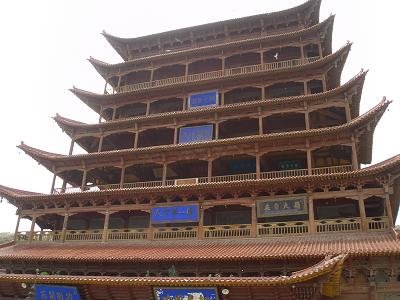
Normally I'm pretty enthusiastic about saying "no" to the many random job offers that come my way, but occasionally I can be talked into doing one lesson at a school in my spare time. Today I rode an hour-and-a-half bus to the town of Shandan with my student Peter, who asked me to come to the school he worked for over the summer, and I agreed because I had heard good things about the town. I gave an hour-long lesson to 9 year-olds, which was 5% showing them photos, 10% going over "hello, how are you?" and 85% improvisation. Photos from home are a sure winner but in this case were a mistake, as I was literally stampeded by students leaping from their seats to grab them. They eagerly set about looking at/destroying them, and at the end of class ran out with them all before I remembered to ask for them back. I also made a little boy cry. That sounds terrible, but all I did was ask him "What do you like to do?" when we were working on that, and I terrified him so much I saw tears forming in his eyes. The lesson actually went fine, and a sycophant from the school went so far as to applaud my brilliant teaching "strategy" of just using English, instead of Chinese and English, to teach the children. The high point of the day was a visit to the "Great Buddha Temple", which they guessed with great uncertainty was 1000 years old. It was a fantastic seven-story pagoda that housed an absurdly large Buddha statue, with the face painted in gold. They claimed it was the largest seated Buddha statue in all of China, but they also claimed that the nearby horse breeding-ground is the largest in the world, which I cast a skeptical eye on. Funny that places like this just lie about unnoticed in China; I had never heard of this Buddha temple until, say, 11:45am today.

I also had the pleasure of facing Miss Mao in ping pong. Miss Mao is the highly energetic, highly entertaining, and highly taller-than-normal waiban of our school, who is the person keeping an eye on the foreign teachers and being bothered when our toilets don't work. I called to let her know I was back, and she mentioned ping pong in answer to my question about her summer. I had barely finished mentioning we should play sometime when she said "tomorrow morning!". When I showed up, before I could greet her or even cross half of the room she said "lai! ("come" or perhaps "let's go!")" in a loud voice and marched to a table. I held my own, but that's not to say I won any of the many games. I think she was just toying with me.

Due to a mysterious woman we are calling the "vice-dean" because we don't care for learning names, things seem strangely organized this term. We even had an English department meeting, unbelievably, the first "meeting" I've seen of any kind. There was even a hand-out, with only one English mistake. Things are shaking up around here, sort-of, and seeming almost "job"-like. Of course, I was called and told about the 10:30am meeting at exactly 10:27am, so I can take comfort that some of the general chaos and disorganization will remain. Otherwise the place wouldn't be the same.

Thursday, August 24, 2006

Xinjiang Travels: Part VI

Day 30 (8/18) - Urumqi

The sleeper bus arrived in Urumqi in the afternoon , and to my astonishment we were only one hour late. Urumqi is Xinjiang's black hole which I was now passing through for the fourth and last time, in order to get a train back to Zhangye. So I checked into the same hotel and set about killing another evening.

With hopes high, I decided to give Hu Yan a call, the girl who gave me her phone number last time I was in town. She sounded genuinely delighted to hear from me - and was also in the city of Hami for the weekend. I lead the romantic life of a poorly written sitcom character. This was especially appropriate because I had considered going straight to Hami, since it's about halfway to Zhangye and I could visit the British teacher Tracy who just left Zhangye for Hami.

As I paid for the phone call the shop owner, who undoubtedly would have been listening in on my struggling Chinese conversation, wanted to show off her "English-speaking" daughter. To my totaly surprise she did speak extremely quiet and nearly-fluent English, and I didn't know to make of her. Some Uyghurs could pass as Westerners, and she looked like a British imposter working undercover in a Uyghur convenience store. I guess she actually was Uyghur, but has been living in Australia.

With nothing to do I once again headed to Fubar, the Western bar. There is a middle-aged man I have seen there every time who depresses me because he looks like a lonely, balding version of me. He probably teaches English. A small group of regulars and an owner were pre-occupied at the other end of the bar with a new toy - a large hour-glass monstrosity with multiple taps for dispensing absinthe, which was taken down from the shelf. One of them was telling an absinthe story from Norway that ended with him not remembering a full day in which he took a plane to Beijing, without any of his luggage.

After a while, an older Chinese man struck up a conversation with me in English. He introduced Tian Tian ("Heaven"), the pretty and much younger girl sitting between us, as "my girlfriend... but only for tonight." Sympathizing with my traveling alone, he related his visit to Australia - "I sat alone in the pool. I had no lover. Not interesting." Tian Tian involved herself in the conversation by toasting my glass every two minutes. Even among a group of people, drinking from your glass alone is considered rude or at least odd in China.

Back in my hotel room, I had to ignore several calls from the local brothel, who I could hear making the rounds of all the rooms. When they called earlier they sounded so bored and listless I thought it must actually be the front desk, until they managed in terrible English "do you want a massage?". Mostly I was just bothered by them calling each night when I was trying to sleep; I need to learn how to tell people off in Chinese.

Day 31

For about the twentieth time in Xinjiang I ordered zhua fan, a good lamb and rice dish. That morning, however, I got a special bonus - a front-row view of the skinless and headless animal gracing another table, which the cook soon set about sawing in half. Call me old-fashioned, but I tend to like kitchens with walls.

Allow me to once more vent my frustrations on buying train tickets. I would best compare it to getting tickets for the most popular rock tour in America, except they can only be bought in person with cash in the city of the show, and go on sale about 5 days beforehand. Even the travel agencies (the "ticket scalpers" you might say) had no tickets, so I went to the station to see what I could turn up. Chinese people have only the barest concept of the line, and the closer you get to the front, the more prison rules set in. Someone just behind me elbowed me out of the way and quickly ordered, but when another person behind me actually reached their arm over me with money in their hand and shouted what they wanted, the counter woman angrily told him to wait his turn. There were no sleeper tickets to Zhangye (or anywhere I expect), just hard seat tickets, so I got one that left in two days and hoped I could upgrade on the train, which I've been told is easy to do. This was a huge mistake, but more on that later.

I spent the rest of the afternoon using the internet in one of the numerous internet cafes in Urumqi. For some reason internet cafes ("net bars") in China are always in ill-lit, smoke-filled and seedy basements, like modern opium dens. And for some they seem almost as addicting - the only student I failed last term was apparently a net bar addict, who never attended any of his classes or even his final exams. For dinner I decided to treat myself to a Brazilian barbecue restaurant called Sabbath I had heard about, which had live music. When I told the waitress I was alone she laughed and said "only one?", which of course didn't make me at all self-conscious. The band was terrible, though they seemed to be actually Brazilian. Maybe classy Asian bars and restaurants act as a dumping ground for mediocre Western musicians, like in Lost in Translation. I should move to Shanghai, brush up on "Hotel California" and "Scarborough Fair" , and start a jazz band. The food was good, but shockingly expensive - about 12 times what I normally pay for dinner.

With nothing to do but go to a bar again, I figured I could at least try a new place. I don't know what the bar I went to was called, but it was aggressively promoting Carlsberg "Chill" beer and I couldn't think of a more appropriate name for the place. It was trying very hard to be cool, with Western movie posters and a tiny see-through dance floor equipped with a dozen lights and even a smoke machine. However, it was definitely cheesy and definitely lacking in customers for a Saturday night. I sat in one of the booths, but was soon told to sit at one of the plain tables in the middle because the booths for reserved for certain people. I then noticed the tables were labeled "B" and the booths were "A", and actually at a higher elevation. I didn't understand, or really care, what you needed to do to get into an "A" booth (Party official?). The server wanted to know what the word for "bar" was in English, which I supposed might be the height of my conversation success there.

I was quickly bored and a little self-conscious about being alone in such a big, empty place. However, there was an attractive and bored-looking Chinese girl sitting alone in a booth who seemed to be casting glances in my direction, so I figured it couldn't hurt to try invading "A" territory one more time. She made no objections to my sitting there, and we proceeded to have two different conversations. She would repeat what I said to herself, making it obvious she heard something else each time, so I imagine it went something along the lines of "I work as an English teacher" "Oh, so you just got out of prison, interesting." Then she would say something to me I didn't understand at all, and I would smile and nod in agreement. Alas, the scintillating conversation was interrupted by the server, who in nervous English said:
"If you want to talk to her, you must pay, 20 yuan per hour"
"Huh? You mean to sit here?"
"To talk to her"
Then she said something about how she was working, and the wheels slowly clicked into place.
"Ohhh.... I didn't know. No thank you" I said, making my exit. I suppose that was less awkward than it might've been if he hadn't said anything.

On the street I heard what sounded suspiciously like a live band, and to my surprise there actually was a band in another bar. I'm not sure I'll ever be impressed with Chinese rock music, but they really had some life to them and were fun to watch. For a couple of songs there was a talented female singer, including one which seemed to be in English, although the only word I could make out was "Jesus." I would love to see more live music in Zhangye, but I won't be making any plans to move to Urumqi anytime soon.

Day 32

I had yet to see the market and Muslim quarter of Urumqi, which turned out to be the most interesting part of the city I know of. There happened to be another backpacking Westerner at the restaurant I ate lunch at named Derek, and when we struck up conversation he turned out to be a Peace Corp volunteer who also knew Julian and Cynthia, the PC teachers who had just left Zhangye. Small, strange world when you travel. As he taught at a medical college he had done a unit on sex ed, which he was sure was going to get him fired when the students started bringing things to their presentations like condoms on cucumbers and a videotape of a cat, well, pleasing himself. I always wonder what's really going on behind the innocent faces I teach. I thought my being in Urumqi a day longer than expected might at least allow me to meet up with that girl Hu Yan, but as I should have surely known before calling, the cruel masters of fate responded by delaying her weekend trip another day.

Day 33

My last day in Xinjiang. My train left around 7pm, so I had time to finally see the museum in Urumqi. I was pleased to see a proper museum, with air-conditioning and more than one room, more than one floor even. There were good displays about the numerous ethnic minorities Xinjiang and the region's history (which, as told by the plaques, is nothing but an inspiring account of varied ethnic "brothers" working joyously towards the common goal of development and securing the borderland). I enjoyed the miniature models of places I had actually been to throughout Xinjiang. As in the Hotan museum the highlight was the mummies, with a whole room dedicated to them, including a bizarre fixation on the "Loulan Beauty" with both a painting and a full-size clay model guessing what she looked like before she was a shriveled, decrepit mummy.

And then it was time to board the last train. I tried to head directly for the desk that upgraded tickets, but was waiting in the wrong spot and ended up as a late arrival in the small, aggressive crowd. I was told there were no sleeper tickets when I did get through to the ticket woman, and got the same news when I checked back later as some were told to do. I'm not sure what quirk it is in the ticket system that allows there to be sleeper tickets available to be purchased on the train when they are impossible to get beforehand, but it turned out to be a false hope. As I thought might likely happen, I prepared myself to sit in "hard seat" class for the 15 1/2 hour overnight journey to Zhangye, wishing again I had broken up the trip by stopping in Hami. The guide books generally recommend not getting a hard seat ticket for a trip of more than 4 hours. It was fine for the first six hours or so, but as about 8 hours passed and it got towards the time I ought to be sleeping, my tolerance started to wear very thin.

Day 34 - return to Zhangye

The last 7 or 8 hours truly sucked - the bright lights worked against the tiny shred of hope for sleeping I had, and the crowded aisles weren't really a break from the cramped seat. I had to remind myself that I was only of hundreds of people doing this (no empty seats, most continuing further to Lanzhou) and they mostly seemed to take it in stride, playing cards and joking around and, somehow, sleeping. The Chinese have developed an amazing talent for not being bothered about things. Nonetheless, the last hours passed painfully slowly, especially when the train was delayed by one and a half hours, and after 17 hours overnight in a seat I was less thrilled during my return to Zhangye in the morning than I expected. I also managed to get some kind of illness in that time, so my first 48 hours back in Zhangye have mostly been spent sleeping and feeling like I got in a fight, and lost.

However, two days later I'm returning to normal, and enjoying the normalcy of being in my apartment and a city I'm on good terms with. Even if I pulled together the funds, I'm not sure I would fully enjoy one of those one-year round-the-world backpacking epics some people do, at least not on my own. I've been fortunate enough in life that I have difficulty saying which trip was the best, but Xinjiang definitely lived up to expectations. Along with the longest time I've spent traveling, the trip could be described in numerous dramatic exclamations - the farthest city west in China ! the hottest spot in China! the second-lowest place in the world! the largest province in China - 1/6th of the country, and four times the size of California! the farthest city from the ocean in the world! mountains! deserts! colorful minorities! camels! Actually, after a full year I'll have seen little of the most typically "Chinese" parts of China, though there's always time for that later. Out of curiosity I've made an estimate of the number of hours I spent on buses and trains between cities on the trip, and came up with 192, or about 8 full days. It's surprising that "Xinjiang" is a name pretty much unheard of in the West, but like most I couldn't name more than about three cities or any of the provinces in China before coming. Nows it's back to the life that I've come to know here - running into students on the streets (and forgetting their names), walking beneath the bright lights of Zhangye at night, and forgetting what it was to be anonymous. It's good to be back.

Wednesday, August 23, 2006

Xinjiang Travels: Part V

Day 26 (8/14) - Yarkand

My next stop along the Southern Silk Road was Yarkand, which proved to be a lot more memorable than Yengisar. The area around the bus station and my hotel was Chinese, modern, and nothing particularly interesting, but just a bit to the east was the utterly different Uyghur old town. Transportation around town was by small motorcycle-powered pedicab, with me seated in an uncomfortable cart in the back or a covered bench. Many of the drivers were children who looked to be about 6 years away from a driver's permit in America. One tired-looking man powered his cart by bicycle, which felt like a very bourgeois thing to be taking advantage of.

The main tourist attraction of Yarkand is the Altyn mosque complex, an ancient and well-attended mosque with some surrounding spots of interest. The most striking building is the tomb of Aman Isa Khan, the musician, poet, and wife of the local ruler in the 1500's and famous for collecting the 12 muqams, important traditional Uyghur songs. A portrait of her holding a dutar is popular throughout Xinjiang. To the side of her tomb was a small cemetary of the tombs of royalty of Yarkand, with all the graves having been built in a similar, peculiar style with a curved top. Behind the mosque complex is a very large cemetary, a shady place with few people. I've always liked cemetaries for some reason, maybe because of the guarantee of peace of quiet.

The old town that began in the streets around the moque was reminiscent of Kashgar's, but perhaps a little more colorful, and certainly more off the beaten tourist path. The locals struck me as just a bit friendlier as well. I bought two small knives from a group of excitable boys, who ran inside to get a newspaper and pen so they could write down numbers and barter with me. On one of the "main" streets I stopped for some Uyghur ice cream, and in two strange minutes witnessed a man basically beating his son in the street, a small cart get hit and nearly demolished by a large truck, and a man walk by with an enormous tumor coming from his forehead that had an eery resemblance to the pictures of Confucius on the bottles in front of me. Confucius is said to have been very ugly and is usually portrayed with a bulbous, bulging forehead to represent his wisdom.

In a restaurant near my hotel, the TV was showing a Chinese movie with a Western doctor as the main character. They actually portrayed the doctor speaking English and using a Chinese translator the whole time, and I was intrigued enough to finish it in my hotel room. I finally realized it was about Dr. Norman Bethune, a Canadian doctor who helped China in WWII and Chinese children all learn about. Apparently his Chinese name was "White Doctor", or at least that's what they called him in the movie. Which may have been an on-going series as it ended on a weird note, with his daughter refusing to use the smelly outdoor "bathroom" and him saving the day with a new "ladies only" toilet. As could only happen in a Chinese drama, there was a full six or seven minute scene about someone making a bowl of noodles, which included dialogue along the lines of:
"White Doctor": What are these noodles called?
Chinese Man with Unnaturally Wide Smile: Dao Mian!
WD: Dao Mian!
Small Grinning Child: Dao Mian!
Chinese Man, now with wider smile: Dao Mian!
Second Small Grinning Child: Dao Mian tastes really good!
(Chinese Man now gets cocky, placing the flour he's been cutting into pieces on his head and landing them all in the pot)
(cut to about two minutes of White Doctor eating noodles and having the time of his life, moving on to a second bowl and finishing with a satisfied belch)
I remember once watching a drama on TV with some student friends, and one scene began with a long close-up of the food the couple were eating, before finally scaling back and starting the dialogue, which made the students gasp and exclaim "oh that looks really good!". As the writer Lin Yutang put it, Chinese biology never did advance very far because a Chinese person can't look at an animal without focusing on how best to cook it.

In the evening, I decided to go a little deeper into the old town, which was the best thing I could have done. The old town turned out to be pretty large, and the further I explored, the further I felt I was stepping back in time. Besides the motorcycles powering the carts, the large coolers outside the shops, and a few other details, the place didn't look like it had changed much in 400 years. The whole place was dusty and narrow and ancient, and through the numerous open doors I could see the courtyards and furnishings of the traditional one-story homes. I drew quite a lot of friendly attention, especially from children. One child followed me timidly, until she found her friend and the two of them excitedly bounded up to me. She was wearing a dirty white dress that made her look like Miss Havisham in a children's performance of Great Expectations, and said "rekmet! [thank you in Uyghur]" in a tiny voice when I showed her and her friend The Pirate the pictures I took. Three blacksmiths stopped what they were doing to stare at me, and when I motioned I would like to take a picture, they used body language in turn to suggest "sure, but let us start doing something again!" and got to work, quite amused at their picture I took. As I was buying a bottle of water, I suddenly felt something grab my shoe. A man older than me had bent down to get a good feel of my sneakers to see what they were like and grinned up at me, although I'm not sure what was so interesting about them. After an hour or two of wandering I was taken back to reality by the presence of a car, but it was stuck in all the sand and dust of the alleyways and was being pushed by a small army of children. There are many things to look for in a travel location: famous sights, scenic beauty, nightlife, etc., but I think I'm truly after the general atmosphere of a place and its people, and I'll remember Yarkand as one of the highlights of the trip.


Day 27 - Karghilik

On the way to Hotan, the only big city east of Kashgar, I stopped briefly in the small city of Karghilik, called Yecheng in Chinese. I was hoping to spend several hours there but there were communication difficulties finding out if there was another bus to Hotan after the next one, so after getting some noodles for lunch I only had an hour. The main sight of Karghilik is the Friday Mosque, which was worth getting a quick look at and is surrounded by shop-lined streets. I didn't have enough time to get a sense of the city, but it seemed like a decent enough place.

The bus to Hotan was meant to take five hours, but I've learned by now to take time estimates lightly in China. After a while it became obvious there was engine trouble, and finally about halfway we stopped with a thick cloud of smoke coming up from the engine near the front and spreading throughout the inside of the bus. Luckily I had a window seat and could stick my head out. We were quite far from anything resembling civilisation when we broke down, so I took a stroll around the desert and maintained some faith that they would fix it like they usually do. At one point while we waited I was the victim of another curious shoe-grabber, again without warning. After he was satisfied with his inspection of my sneakers, with a triumphant smile he insisted I feel his shoes as well. We did start up again after an hour or an hour and a half, but with frequent short breakdowns from then on. Finally, I just abandoned ship as some others had done and got an empty seat on another bus to Hotan for 10 yuan, arriving 7 hours after departure. If I was traveling much longer, the hours of late arrival would soon add up to a full day by themselves.

Day 28 - Hotan

Despite it's very remote location south of the Taklimakan Desert, Hotan is a fairly modern and crowded city, and to me didn't have quite the alluring atmosphere of Kashgar or Yarkand. Hotan is known for making rugs, silk, and especially jade which are famous throughout China, and many of the sites relate to this. There is a small village called Jiyaxiang just outside the city which has a little workshop that makes silk using ancient methods (and ancient people as well). It was a brief but interesting visit, but was overshadowed by my annoyance with my unscrupulous taxi driver, who wouldn't leave unless I also gave him some money for his return trip because he didn't think he'd find someone on the way back that far out. I would rather have walked back most of the way through the village, but the woman at the workshop insisted he was right and there were language difficulties, so I ended up giving him another handsome sum to get me back into town after he waited for me to finish my visit.

I explored the city a bit more, and browsed some of the jade stores. Most of the stuff was quite nice, and also well beyond what I thought Chinese people could afford, but they don't get all that many Western tourists in Hotan. For lunch, I decided to be adventurous in a large Uyghur restaurant and just point to something that I didn't know the Chinese characters for, though the last one suggested it was some kind of bird. A bird indeed it was, just a flame-broiled bird on a plate with the head still attached. It's limbs were folded in a hideous position, that brought to my imagination that it was burned alive while crouching in fear. Not the most satisfying meal I've had here.

Day 29

In the morning I went for a visit to the Hotan Cultural Museum, where business was obviously booming - they had to unlock the doors and turn on the lights for me. It was small and focused on Hotan's long history as a Silk Road outpost. The highlight was certainly the two small mummies in the center of the only room, which still had some hair intact and were incredibly eerie.

I also went to visit another, much more modern silk factory which I read about in the Lonely Planet guide. It was out of the way and the guards were positively amused to see me, and radio-ed someone to say "there's a foreigner here". The woman who emerged and gave me a silent tour seemed much less amused to have to drag me around, but the multi-building complex was worth the visit. I didn't bother trying to prove I could speak some Chinese since I was definitely in over my head vocabulary-wise, and she said little the whole time besides pointing to an assembly line and saying "good" in reference to the boxes of good silk worm cocoons at the end of line, and "bad" in reference to the bad cocoons being picked out by the woman workers. In one building I was shocked to see that they weren't wearing ear protection, since the sound was so loud you wouldn't be able to shout into the ear of the person next to you.

In the afternoon I climbed aboard a sleeper bus and began the mammoth 24-hour journey back to Urumqi through the long, lonely Cross-Desert Highway that cuts through the Taklimakan Desert. There was almost, but not quite, enough room to fully extend my legs in the bed I occupied for a full day, and it was difficult to so much as turn on my side, and impossible to sit upright because I was in the bottom bunk. The sleeper buses in China are roughly the size of a big Greyhound bus in America, but made for 30 people to lie down in three rows and two levels. We stopped twice in the first two hours, first for them to look at the engine and second for a half-hour wait for an accident, but to my great relief these were the only unexpected stops, and the ride was as close to smooth and comfortable as could be hoped.

Xinjiang Travels: Part IV

Day 24 (8/12)

I told Waili I'd stop by the shop, and with a mischievous grin he asked if I had a good time the night before. He told me his father scolded him for getting home too late. He's 28 years old. He treated me to some Uyghur "ice cream", chips of ice shaved from a big block into a bowl with flavoring. He also helped me pick out some Uyghur music CDs and cleared up my confusion about the half-dozen people playing a simple, monotous beat on the drums on the street all day, every day. A new supermarket had opened, and in celebration the drums would keep up the street performance for 15 days, or even 30. Drums are also used to announce weddings, so they're the Uyghur equivalent of Chinese fireworks. I was wondering why trucks sometimes wander the streets with young guys beating away at drums in the back, not that you should necessarily have a reason to do that.

I only managed one tourist-related activity during the day, which was to see the inside of the Id Kah Mosque. The leafy, roofless grounds were pleasant, though surely worshippers mind the tour groups. To me the most interesting thing was the sign at the entrace gate, a fascinating piece of propoganda with all the subtlety of a sledgehammer. After mentioning the restoration of the mosque by the government, the closing paragraph waxed poetic about the perfect harmony and happiness in which Chinese minorities live, and encouraged everyone to work together to fight separatist movements and "illegal religious activities".

The Uyghurs, like many cultures subjected to unnecessarily hot weather, have the amusing habit of sleeping everywhere - in their shops, on a cart, and especially on the patches of grass next to the roads. It's like they got halfway home from the grocery shopping during the afternoon heat and thought you know, screw it, the kids will be alright and this patch of grass is looking pretty good. Not a bad mindset if you ask me.

Day 25 - Yengisar

Besides simply enjoying the atmosphere, I was hanging around Kashgar so I could catch the famous Sunday Market. I had heard it was best to arrive early to avoid the tourists, and that the separate livestock market was more interesting, so I headed there first. The place looked so dead when I arrived that I wondered if the taxi brought me to the right place, but the several tour buses of Westerners served as confirmation. I may have arrived too early after all, and I had an unexplainable urge to turn to someone and say, "boy, there's not much life at this livestock market." It's just as well no one was nearby to receive that paragon of wit.

As the morning unfolded, trucks crammed with cows, donkeys, and sheep made their way into the arena, and things picked up slightly. One bold sheep made a run for his life, possibly having noticed the fly-ridden sheep's heads on the side of the path, but he was quickly shuffled back into the crowd. My favorite thing about sheep is that they sound exactly like people imitating sheep, and not even doing it very well. After waiting a while the chaotic bartering scene I had imagined didn't look like it was materializing anytime soon, and I left with hopes of greater excitement at the Sunday Market.

After having unexpected difficulties getting the taxi driver to understand where I wanted to go (surely every tourist in Kashgar descends upon the Sunday Market), I arrived with anticipation at the event I had structured my week's plans towards attending. However, there was the same strange, dead atmosphere I felt at the livestock market, and I left confused as much as disappoited. I was expecting the crowds of Western and Chinese tourists, but I wasn't expecting there to be so few locals. My guidebook glorified the market and advised "bring twice as much film as you think you'll need"; I took about two pictures. Like a bad album from a favorite band, there was a foulness in the air I couldn't overcome no matter how much I wanted to like it. I did get some useful gift shopping done, but from overheard comments by tour operators and others I suspect the market isn't what it used to be. On the way out I did pass a man selling turtles and baby scorpions, the most satisfying image of the morning.

I felt a bit sad to leave Kashgar, having spent enough days there to grow mildly attached. From there I headed east along the less touristed Southern Silk Road, a series of small towns that are remote enough to have the least diluted Uyghur character. I spent the second half of the day in Yengisar, a small place renowned for making the decorative knives sold throughout the area. Waili had advised against it, saying it was poor, undeveloped, and unfit for tourists. I had been told the same things about Zhangye, so I gave it a shot anyway. He was right; it wasn't interesting, and was the only stop of the trip I should've skipped. It wasn't horrible, and would've been interesting in the impossible event it was the first Uyghur city I'd seen, but the sun was so unbearable I was just torturing myself by being outside. I did get a couple of knives for a good price, but I failed to locate the knife factory and just retreated to my hotel room to read Bill Cosby's "Love and Marriage". You end up with some random things at a book exchange.

Saturday, August 12, 2006

Xinjiang Travels: Part III

Day 18 (August 6th)

An uneventful day spent mostly on the 23-hour train ride to Kashgar, sleeping, reading, and talking to the Pakistani medical students who were in the same sleeping compartment.

Day 19 - Kashgar

Spending time in Kashgar, more than any other place I've seen in Xinjiang, feels like stepping out of China completely. Most of the Chinese I do see seem to be tourists themselves, and it is almost completely Uyghur in character. It is the city farthest west in China and keeping official Beijing time feels the most bizarre, as it is daylight until at least 9:30pm. Kashgar was once an important city along the Silk Road, and is still a place of trading and markets.

Besides its famous Sunday Market there isn't much in the way of "sights" in Kashgar, so the city itself is the attraction. The streets in and around the Old City and Id Kah mosque are lined with fruit stands, kebab houses, and shops selling distinctly Uyghur goods such as instruments, decorative knives, hats, and rugs. Headless, skinned animals hang outside meat shops, and young boys walk the streets with baskets of bread balanced on their heads. Besides the lamb kebabs and other foods I am familiar with from the Xinjiang presence in Zhangye, there are a variety of new dishes being sold on the street that I haven't always been able to identify (or necessarily recommend).

People watching is fascinating. The young girls wear scarves covering their hair and traditional dresses, while some of the traditional older woman are covered from head to toe and have black veils that hide even their eyes. The men wear the round hats that are a familiar sight among Muslims in China, and some of the old men have the most fantastic beards. It seems even the people selling fruit in the street sometimes don't know so much as numbers in Chinese, so the language barrier is bigger here. As another English teacher who's been in China one and a half years said, "I've experienced culture shock coming to Xinjiang". In a way, it's a little refreshing to get no reaction to my Chinese, rather than the gushing Chinese compliments that can feel patronizing.

For lunch on the first day in Kashgar, I tried a second-floor restaurant on the square with the mosque. The waitress there was fascinating to watch, an unnaturally tall and thin young woman who ran/slid around the busy place in her sandals and Uyghur dress. She knew English, but didn't so much speak it as shot it out like ammunition: "Sorry! I am late!". During the day I attracted the attention of 3 different eager English speaking Uyghurs looking for conversation: a man running an instrument store, a man selling socks from a push-cart, and a teacher from Urumqi named Kurban ("You know Kurt Kurban? Nirvana? He is a good singer"). Mohammed, the man selling instruments, told me of his wish to visit Africa: "I met a black-skinned person the other day. They are very interesting! I pinched his arm, and I wanted to know if his blood was red or was it also black. If a black-skinned person opened a shop here, it would be very popular, because everyone would want to look at him." He was fascinated to hear that I had "black-skinned people" with me at school, and that sometimes they marry white people.

For a late dinner I visited the popular night market that is also near the mosque, where the end of a street becomes flooded with pedestrians and stalls selling various fried foods, fish and meat dishes, glasses of colorful drinks filled from fountain-equipped carts, and the ever-present lamb kebabs. I sampled some foods I had never seen before, which were mostly good, though I decided to pass on the full sheep's head.

Day 20

I had made the decision to stay in Kashgar about a week and relax, and on my second day I had no plans or ambitions whatsoever. As it is put in Office Space, "I did nothing, and it was everything I hoped it could be". The highlight of the day was going to the park for a few hours, surrounded by local families and young couples who hung out on carpets and played cards or songs on the dutar, the two-stringed instrument my friend Aqbar would play in Zhangye. The largest Chinese presence in Kashgar is in the official names of things: "People's Park" runs south of "People's Road", and is to the east of "Liberation Road". In a square to the north of the park is a bizarre spectacle: one of the largest Mao Zedong statues in China, with a confident arm outstretched and rows of Chinese flags to either side. I suppose it's Beijing's reminder of who really controls the area.

At night I went back to the same market, where the stalls were different and I was tempted by the huge legs of lamb. It was rubbery and revolting, but was worth a try. Better were the lamb kebabs from a restaurant on that street, where there were tables outside that were actually beds with a small table in the middle, where you could take off your shoes and sit comfortably while having some tea and kebabs. There were many places like this in Turkey. It's incredibly relaxing, and I'm not sure why it hasn't caught on in America.

Day 21

I set out on bicycle for several hours, passing through the streets I had already explored before continuing on to the famed Sunday Market area. It was Wednesday, but the market is there everyday and I thought I'd see it first in its tamer guise. Apparently, about 50,000 extra people flood Kashgar each Sunday for the market. I was reminded of the Grand Bazaar in Istanbul - it was indoors, and a maze of alleyways wound past stalls with jewelry, carpets, instruments, or simply bicycle tires and car parts. The place was lazy and without many people, and the vendors lacked the usual enthusiasm to shout "hello!" as soon as they saw a Western tourist.

I also visited a Uyghur crafts store, a high-class place with hand-made jade figures and various jewelry. The prices were shocking, with many larger pieces going for well over my year's salary, and I wasn't really planning on buying anything anyway, but I figured I'd take a look at what they had in my price range. They had to pull out a special bottom-of-the-barrel box from behind the counter with assorted small pieces of carved, impure jade. They had figures of the 12 animals in the Chinese Zodiac, so I took a look at mine, the glorious pig. It was a small but nice enough figure, which they quoted the price 220 yuan for. I slowly worked them down, and the mood changed when I told them I was an English teacher in Gansu province, so I bought it for 80 yuan. I don't know what a fair price was and I was just mildly interested, but the bargaining success was fun in itself.

While browsing a store near the mosque and admiring its painted tamborines, I got into conversation with the man working there, a middle-school English teacher who helps out at his brother's store during the summer. As so many random people have here, he had a Gansu connection, having gone to college in the city of Lanzhou, so my job was again an in into a good conversation. His name was Waili (sounds like "Vie-lee"), and we hung out talking for a while as I tried different Uyghur instruments, all made by his family of 8 siblings. He talked fondly of his foreign teachers from university, and obviously missed the chance to speak English with foreigners.

Day 22

I took a day-and-a-half break from Kashgar to visit Karakul Lake, about fours hours away by bus along a scenic mountain highway. This was the last of the three famous mountain lakes in Xinjiang, and became my favorite. I had heard rumours of the road being washed away in parts, but didn't bother much about them. Sure enough, about a half-hour away from the lake the bus stopped, and what little traffic there was became backed up. One of the other foreign travelers joked that we should just walk - it would only be two or three hours. As luck would have it, we sat around not moving or knowing what was going on for a full four hours. We should have walked. So, the four hour journey became eight hours, and I was reminded how much I enjoy trains.

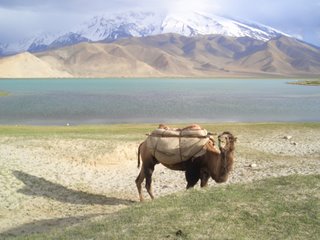
Surprisingly, there were very few tourists at the lake, nothing even beginning to approach the numbers at Tianchi and Kanas Lake. The area of the lake itself is small, but I appreciated that it involved neither a long uphill climb or trekking over a large spread-out area. I also thought it was the most breathtaking of the three lakes, indeed it was spectacular, and I would challenge any artist in the world to create a more beautiful landscape. There was complete silence, and I stared alone at the snowy, cloud-capped mountain that is the centerpiece with a feeling of enormous well-being. Because of the late arrival there was no time to try climbing up any of the mountains on the other side, so I decided to just make a circuit of the lake. This was harder than expected - probably because of the recent bad weather, a tiny but challenging river snaked across my path about a quarter of the way around. I found a place to cross, but the land became more and more like a swamp as went along. I was sure I would find enough footholds to complete the journey and pressed on, but after an hour there was simply too much water to go any further, and I retraced my steps in defeat.

Like at Tianchi I stayed overnight in a yurt owned by herders, this time a Khyrgyzh family rather than Khazahks. I was the lone boarder at that yurt and they spoke about 10 words of English ("noodles!" was the enthusiastic announcement for dinner) and no Chinese, so it was a more idyllic and romantic yurt experience than the backpacker hangout at Tianchi. I became very curious about the lives of these people - funny-hat wearing Manas, his pleasant round-faced wife Wuljun, and child Mustapa, who had learned to say "Hello!" and made damn sure I didn't forget it. There were no books, instruments, or anything that didn't directly have to do with surviving, and I'm curious what they do with their days. I tried to get answers from a young friend of theirs who came in and spoke some English, and he said his interests were "business", which I gathered from his constant attempts to sell me anything from a hat to a motorcycle ride.

Around 3am I snuck out of the yurt to use the bathroom, and the grey-washed scenery at the time was so surreal and otherworldly that I won't soon forget it.

Day 23

For breakfast Wuljun served some bread and milk tea, and the three of them watched everything I did with curiosity, and casually looked through my notebook and possessions. They were an especially attentive audience when I put in my contact lenses. I wished I had brought postcards or something of interest from the outside world for them, and I decided to leave them a photocopy from my Chinese textbook, which fascinated them. I very easily flagged down a bus to Kashgar on the side of the road, and we waited merely one hour on the return journey. Besides terrible 80's music videos they showed Mr. Bean, which brought a broad smile to my face. I shudder at most of the Western culture the Chinese have imported and are forming their ideas about us on (The Backstreet Boys being by far one of the best known), so it pleasing to know Mr. Bean is available dubbed in Uyghur and sub-titled in Chinese.

Waili, the Uyghur man I met at his brother's store, had wanted me to stop by again and possibly go out for some drinks, so I decided to take him up on the opportunity. Chance encounters like this with local insiders are one of the best results of hanging a place with no rigid schedule. First we went to a night market for a few kebabs and beers, as it was still evening and the bars would also be much more expensive. He showed me the Uyghur style of drinking, in which one person alone has a full glass, and while they are drinking it is their turn to carry the conversation, until they finish and the next person drinks solo and talks. I also learned cheers in Uyghur (something like "huoshe") and a drinking game in which tiger beats chicken, chicken beats insects, insects beat stick, and the stick beats the tiger. He had a little of funny and interesting things to say, such as the time he had dinner with one of his foreign teachers, a tall and overweight American woman. He was amazed at the amount of food and beer she could handle, and not knowing the word for "appetite", he blurted out "you really have a big belly!" and couldn't understand why she got angry. He clearly admired America, such as its principles on human rights and freedom of speech. The people of Xinjiang are different in every way from the Chinese and don't necessarily love being ruled by them, something I finally got the chance to ask a local about. He was also fascinated by the strange things Americans do - "I read about a kissing contest, and the winning couple kissed for 30 hours! It went right into Guinness World Records." When it was time to head to a bar, he asked if I wanted to see a Chinese or a Uyghur bar. The difference? "Different music, and in a Uyghur bar there are only Uyghur people; in a Chinese bar only Chinese people go." He also wanted to know if I wanted to the best bar, or to a cheap bar where people get in fights.

I have no doubt the bar we went to must have been the best Uyghur bar in Kashgar. There were two uniformed staff to greet us at the entrance, and waiters in bow ties served tables inside. A typical large bottle of beer in China from the store costs 2 or 3 yuan; here there was a 30 yuan spending minimum per person. A bowl of popcorn was 10, and small foreign beers 18 each. There were two floors, with the second floor balcony looking out over the large dance floor. The music was all Uyghur, and there were not but one a series of live singers, and two separate solo dance performances from beautifully dressed girls that were nothing short of mesmerizing. The Uyghur people have dancing in their blood, and they had a funny way of doing it at a club - everyone would converge on the dance floor simultaneously, and leave it just as quickly when the song ended. I couldn't tell the difference between the songs meant for dancing and the ones meant for sitting and talking.

At the table next to us were four girls, who would dance in pairs during the appropriate songs. One of them was absolutely, unbelievably beautiful, far and away the most attractive in the building. Feeling an unusual confidence that could only come with a mix of beer and being in a foreign country, I asked Waili to ask her to dance with me, relieved that not knowing the language allowed me to put the task to someone else. But he was no braver than I was, saying "I don't know, I'm too shy!" After a few songs he went over and asked, showing his head with disappointment as he returned to our table. Perhaps she was unimpressed with my shabby jeans and a t-shirt that now had an unmissable stain from eating kebabs.

After a while Waili convinced me that we should get on the dance floor during an upbeat song, so I tried to follow what he was doing and was glad that the Uyghurs don't stare at foreigners anywhere near as much as the Chinese. And it didn't go half as badly as expected, at least according to my judgement at the time. Waili less-than-subtlely drew us nearer to the four dancing girls, and they acknowledged us with knowing smiles as they continually floated away. During the next dance song they softened, and we ended in a circle of five with one of the girls dancing in the middle and smiling at everyone in turn. This was immediately followed by a slow song, and to my surprise the center of the circle lingered and then began dancing with me. It wasn't the Aphrodite, but I suddenly realized how attractive she was in her own right. I began by making an ass of myself and putting my arms in the wrong position, which she had to correct, and I was probably a less than inspiring dance partner after going so long without a slow dance. I noticed Waili dancing with the girl I had my eyes on all along, which was cut short because he left to greet a friend who had phoned and wanted to meet him at the bar.

His friend was a timid, pretty girl who was apparently a doctor, which may have been a mistranslation considering how young she looked. She said almost nothing and ordered a soft drink, and then wanted to leave after about 20 minutes. I was of the mind to stay, so I let the two of them leave first. During the next available song I asked the girl at the next table to dance with a gesture towards the dance floor, but she shook her head and waved her hands "no" with a little more emphasis than was necessary, pointing towards her friends as explanation as she accompanied them to dance. I'd like to think it was because she was truly unable to leave her friend without a dance partner, and not because our dance had been that traumatic an experience. At any rate, a fun and unexpected night out in high-class Kashgar.