Saturday, July 07, 2007
Chinese Words and Phrases 2: 帮我一个忙 bāng wǒ yīge máng
Bang wo yige mang means "help me out with something," generally prefaced by "could you..." and is a phrase to be wary of in Chinese. One of the unexpected bonuses of being a foreign teacher in China is the chance to be volunteered to help people you don't know improve their English. And thus a neighbor who is a chemistry teacher has dropped by with his 26-page research paper for me to look over before he submits it to a scientific journal. This is clearly a better use of my time than the 274 final exams I have to grade, and besides that makes for exciting reading. The title is "An Investigation on Synthesis and Photocatalytic Activity of Polyaniline Sensitized Nanocrystalline TiO2 Composites," and the first sentence is typical of the rest of the paper: "Polyaniline (PAn) sensitized nanocrystalline TiO2 composite photocatalystPAn/TiO2) with high activity and easy separation had been facilely prepared by in situ chemical oxidation of aniline from the surfaces of the TiO2 nanoparticles." I told him no on account of being too busy, leaving out the fact that I don't even understand it in English (my spellchecker backs me up by claiming most of these are not real words). Actually he's a perfectly nice guy who had me over for dinner the last time I helped him, but I have few outlets for sarcasm these days.


Wednesday, July 04, 2007
Qinghai Travels, Part IV: Turning Down a 15-Year Old Girl in Marriage

There was a colorful and attention-grabbing temple in the town which afforded great views from the top. Andrew wasn't too taken with temples and while me and Stephen explored and caught a few minutes of monks performing music, Andrew remained in his element outside, talking with a small crowd of people in Chinese. In the 20 or so minutes we had been gone, he had already received a marriage proposal to a shy, pretty 15-year old Tibetan girl. A jovial woman was half-jokingly (maybe) trying to talk Andrew into the deal. "Are you her mother?" Andrew asked. "No, her sister!" "Her close sister? [it's common in China to refer to cousins as brothers or sisters]" "Nope!"

While searching for a bathroom on our way out, we walked through an outdoor pool hall. The crowd of 96% young men all paused in their games to look at us, and if it were a movie it would have been the scene where we knew we had stepped into the wrong bar. A small boy came up to Stephen and begged in Chinese "Foreigner! Take our picture!" Several times Chinese people have said to me "I guess in America you call us foreigners, huh?" And then I picture an American pointing and staring at a Chinese person on the street and saying loudly to his friend "foreigner!!" He would look like an ass, but we are on the receiving end of this several times a day in China. Fair enough that we draw attention when there are so few of us, but I do resent the lumping of every single foreign country into one single "not Chinese" category, and tiresome comments like "foreigners have blond hair. Why is your hair the same color as ours?" After a year and a half I don't think I have been called a Westerner here even once, simply "foreigner."
Upon returning to Yushu we went out to dinner with Natalie, the woman from South Africa who we met randomly on the first day in town. She took us to an authentic Tibetan restaurant (which had been surprisingly hard to find during our stay) and we had a pleasant conversation over a decent meal.
The next day was the epic return journey to Xining by sleeper bus, and after saying our goodbyes to the beautiful Tibetan girl in the hotel that had befriended Andrew (so many missed opportunities), we set off. This bus was in fact a sleeper, to our great relief, but we soon had other things to worry about. I'm not overly picky about cleanliness, especially in China, but the bus was absolutely filthy, and smelled. The blankets were so disgusting that we refused to use them, throwing them on empty beds where they were later claimed by other passengers. I already knew the road was rough, but the bus was in such poor shape that it shook dramatically for the entire 17 hour journey. It felt like being in a violent storm at sea, or asking a couple of friends to shake your bed for 17 hours straight. To top it all off I wasn't feeling particularly well, possibly due to the high altitude. Near Nangqian we had seen signs declaring over 4,300 meters and I was feeling a little lightheaded in that town. The supremely greasy rolls I had bought for the journey didn't go down well (I still can't look at similar rolls without feeling sick) and finally I had a hearty vomit or two on the bus. Fortunately I had empty plastic bags with me, but unfortunately (at least for Stephen and later Andrew) I was in the middle row and had no choice but to ask my friends to dispose of them out the window. Oh, the ups and downs of China. When traveling through her she's as fickle as a Greek goddess, but you love her just the same.


Qinghai Travels, Part III: The Tibetan Al Pacino
note: yes, I am still writing about what happened in May. This is due mostly to my laziness in writing this blog lately, but I also have somewhat of an excuse in that the internet on campus has been down most of the time in the past week or two.

The day after arriving in Yushu we visited the Princess Wencheng Temple, one of the noteworthy sites of the area. Princess Wencheng was a famous Tang dynasty princess who was married to a Tibetan king named Songtsan Gambo (the enormous statue in Yushu was probably him, though I'm not certain) and thereby helped bridge the gap between the two cultures. The temple in Yushu is to commemorate her passing through the area, and apparently there are two Tibetan festivals to honor her.
On the bus to the temple we had an unexpected surprise: our fellow passengers were none other than the same migrant workers who had been kicked off the bus on the way to Yushu and presumed lost to the elements and wild dogs. They also got a kick out of seeing us again and we (rather, Andrew) had a friendly chat with them. We also slowly pieced together the story: there is a rare plant grown in the area (called 冬虫夏草 dōng chóng xià cǎo) that is used by upper crust Chinese as an aphrodisiac, and therefore sells for a high price. There is money to be made harvesting the plant, which is not easy to do, and there is a law preventing outsiders from coming in and profiting off it. Thus a permit is required to get in. That, or take an expensive taxi and sneak into town after you've been kicked off the bus after 14 hours, like those guys did. They were in fact not sightseeing at the Princess Wencheng Temple, but rather heading farther on to a place where there was work. They had also reunited with their super-shady baseball cap-donning boss.
 The temple was certainly a pleasant, atmospheric place, quieter and more enjoyable than the more famous Ta'er Si outside of Xining. The cliff sides towering over the building were bursting with colorful prayer flags, and the surrounding scenery was not half bad. The monks living and studying in the temple were a friendly and curious group. I guess it shouldn't be surprising but in general the monks we met on the trip were memorably hospitable and kind. There was only one monk who could speak good Chinese at the temple, and at around 24 was the oldest. After a number of years of studying Buddhism the monks would graduate and move on. They were not allowed to marry, and if they did they would have to permanently leave the order.
 After touring the modest temple we took a walk out into the surrounding countryside. The shy girl running a small store told us there was a primary school about a half-hour walk along the path, and we figured we'd see what was to be seen while we waited for the bus to return in the later afternoon. We did find the school, which was a poor, one-room schoolhouse with just one class of 50 students. The students were at different ages and levels, averaging around 8 or 9 years old, and there were only two teachers. The children poured out of the building after their lesson and took some long, curious looks at us, with a few of the braver ones coming up to say "hello". As with most of the area, they were all Tibetan.
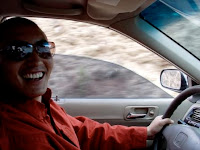 When we returned to the temple to wait for the bus, a monk who was driving into town offered us a ride in his car, which we gladly accepted. He went out of his way to show us a nearby cliff carving of a Buddha, and was quite a cool monk. He was very fond of Stephen's sunglasses which he was borrowing, and seemed to be dropping hints that he wouldn't mind if Stephen gave them to him, but Stephen hadn't brought them all the way from America just to make a monk in Qinghai stylish. The music selection of the day was Buddhist chanting. When he dropped us at our hotel we decided to give him some gas money as thanks. As it happened there was a 20 yuan bill laying on the ground just in front of us. We weren't quite sure where it came from, possibly falling out of one of our pockets, but we gave it to the monk, who declared "money from Heaven!"
 That afternoon we went to the bus station to buy return tickets, and met one of the more colorful characters of the trip, a middle-aged Tibetan man whose English name was Jerry. Jerry dabbled in officialdom, selling pet food, history, amateur philosophizing, and heavy drinking. If he spoke English I think he would have used phrases like "now let me tell you something" a lot. He spoke quite fast and excitedly so mostly the only one who could keep up with his Chinese was Andrew, who Jerry was fond of hitting with the back of his hand when making an important point, at least once spraying the ashes of his cigarette all over Andrew's clothes. He was straight out of the movies, especially in his all-black outfit and sunglasses, and Stephen eventually caught on to his resemblance to Al Pacino.
After a long conversation at the bus station, during which we learned his son was in India studying at the Dalai Llama's school, he decided to show us around town. By "around town", I mean hang out by the river and drink beer and baijiu (Chinese liquor). We were to have company: four Tibetan woman in their late 20's or early 30's, sitting on the rocks and singing to their hearts' contents. They were also wasted. Sadly, only one of them had learned to speak Tibetan, the other three knowing only Chinese. The three of us drank lazily but Jerry hit the baijiu at a brisk pace. The more he drank the more he talked (not that anything had been stopping him), and at one point he went into an amusing string of stories about war, which he acted out as he told them. He was actually a pretty intelligent guy, who had a lot of political opinions and made comments commending the US style of agriculture. 95% of our Chinese conversations are based on "can you use chopsticks?" and "are you used to the food here?" He was also sentimental about Tibet's lack of independence, and told Andrew he identified with Scotland. A young monk also joined us for a little while, and among other things we learned that the 4 big sins for his religion are killing, stealing, drinking, and sex.
When we left the river it was getting on in the evening and we had discussed getting dinner together, but by this point Jerry was drunk and increasingly annoying. We decided to part ways, but subtle hints were not working and he continued to follow us towards our hotel and into our room, jabbering the entire time. Though Andrew was by far the best able to speak to him he was also by far the most polite. He did get it across that we wanted to rest and be alone, and though Jerry agreed in words, he wouldn't follow through in action. He had been in war mode for the past couple of hours, asking me questions like "do you think I'm more of a scholar or a warrior?" Once drunk he had taken a liking to me, describing me as a leader, which I can only attribute to my superior beard-growing skills. Which reminds me: on the first day of the trip the three of us decided that none of us would shave, and thus a beard-growing competition commenced, and may the manliest among us win.
When we left the hotel we was still with us, so we had to resort to drastic measures. We had the advantage of him not understanding our native language, and organized a quick plan. Stephen called Andrew's cell phone, and Andrew answered and pretended to be making plans with a friend. He then explained we had to be at our friend's house for dinner, and really had to be going. Jerry said he would leave, yet refused to do so, talking all the while. Finally I reached the end of my patience and flagged down a taxi, and thankfully he didn't get in with us and we were rid of him. Al Pacino had been given the slip.


The day after arriving in Yushu we visited the Princess Wencheng Temple, one of the noteworthy sites of the area. Princess Wencheng was a famous Tang dynasty princess who was married to a Tibetan king named Songtsan Gambo (the enormous statue in Yushu was probably him, though I'm not certain) and thereby helped bridge the gap between the two cultures. The temple in Yushu is to commemorate her passing through the area, and apparently there are two Tibetan festivals to honor her.
On the bus to the temple we had an unexpected surprise: our fellow passengers were none other than the same migrant workers who had been kicked off the bus on the way to Yushu and presumed lost to the elements and wild dogs. They also got a kick out of seeing us again and we (rather, Andrew) had a friendly chat with them. We also slowly pieced together the story: there is a rare plant grown in the area (called 冬虫夏草 dōng chóng xià cǎo) that is used by upper crust Chinese as an aphrodisiac, and therefore sells for a high price. There is money to be made harvesting the plant, which is not easy to do, and there is a law preventing outsiders from coming in and profiting off it. Thus a permit is required to get in. That, or take an expensive taxi and sneak into town after you've been kicked off the bus after 14 hours, like those guys did. They were in fact not sightseeing at the Princess Wencheng Temple, but rather heading farther on to a place where there was work. They had also reunited with their super-shady baseball cap-donning boss.
 The temple was certainly a pleasant, atmospheric place, quieter and more enjoyable than the more famous Ta'er Si outside of Xining. The cliff sides towering over the building were bursting with colorful prayer flags, and the surrounding scenery was not half bad. The monks living and studying in the temple were a friendly and curious group. I guess it shouldn't be surprising but in general the monks we met on the trip were memorably hospitable and kind. There was only one monk who could speak good Chinese at the temple, and at around 24 was the oldest. After a number of years of studying Buddhism the monks would graduate and move on. They were not allowed to marry, and if they did they would have to permanently leave the order.
 After touring the modest temple we took a walk out into the surrounding countryside. The shy girl running a small store told us there was a primary school about a half-hour walk along the path, and we figured we'd see what was to be seen while we waited for the bus to return in the later afternoon. We did find the school, which was a poor, one-room schoolhouse with just one class of 50 students. The students were at different ages and levels, averaging around 8 or 9 years old, and there were only two teachers. The children poured out of the building after their lesson and took some long, curious looks at us, with a few of the braver ones coming up to say "hello". As with most of the area, they were all Tibetan.
 When we returned to the temple to wait for the bus, a monk who was driving into town offered us a ride in his car, which we gladly accepted. He went out of his way to show us a nearby cliff carving of a Buddha, and was quite a cool monk. He was very fond of Stephen's sunglasses which he was borrowing, and seemed to be dropping hints that he wouldn't mind if Stephen gave them to him, but Stephen hadn't brought them all the way from America just to make a monk in Qinghai stylish. The music selection of the day was Buddhist chanting. When he dropped us at our hotel we decided to give him some gas money as thanks. As it happened there was a 20 yuan bill laying on the ground just in front of us. We weren't quite sure where it came from, possibly falling out of one of our pockets, but we gave it to the monk, who declared "money from Heaven!"
 That afternoon we went to the bus station to buy return tickets, and met one of the more colorful characters of the trip, a middle-aged Tibetan man whose English name was Jerry. Jerry dabbled in officialdom, selling pet food, history, amateur philosophizing, and heavy drinking. If he spoke English I think he would have used phrases like "now let me tell you something" a lot. He spoke quite fast and excitedly so mostly the only one who could keep up with his Chinese was Andrew, who Jerry was fond of hitting with the back of his hand when making an important point, at least once spraying the ashes of his cigarette all over Andrew's clothes. He was straight out of the movies, especially in his all-black outfit and sunglasses, and Stephen eventually caught on to his resemblance to Al Pacino.
After a long conversation at the bus station, during which we learned his son was in India studying at the Dalai Llama's school, he decided to show us around town. By "around town", I mean hang out by the river and drink beer and baijiu (Chinese liquor). We were to have company: four Tibetan woman in their late 20's or early 30's, sitting on the rocks and singing to their hearts' contents. They were also wasted. Sadly, only one of them had learned to speak Tibetan, the other three knowing only Chinese. The three of us drank lazily but Jerry hit the baijiu at a brisk pace. The more he drank the more he talked (not that anything had been stopping him), and at one point he went into an amusing string of stories about war, which he acted out as he told them. He was actually a pretty intelligent guy, who had a lot of political opinions and made comments commending the US style of agriculture. 95% of our Chinese conversations are based on "can you use chopsticks?" and "are you used to the food here?" He was also sentimental about Tibet's lack of independence, and told Andrew he identified with Scotland. A young monk also joined us for a little while, and among other things we learned that the 4 big sins for his religion are killing, stealing, drinking, and sex.
When we left the river it was getting on in the evening and we had discussed getting dinner together, but by this point Jerry was drunk and increasingly annoying. We decided to part ways, but subtle hints were not working and he continued to follow us towards our hotel and into our room, jabbering the entire time. Though Andrew was by far the best able to speak to him he was also by far the most polite. He did get it across that we wanted to rest and be alone, and though Jerry agreed in words, he wouldn't follow through in action. He had been in war mode for the past couple of hours, asking me questions like "do you think I'm more of a scholar or a warrior?" Once drunk he had taken a liking to me, describing me as a leader, which I can only attribute to my superior beard-growing skills. Which reminds me: on the first day of the trip the three of us decided that none of us would shave, and thus a beard-growing competition commenced, and may the manliest among us win.
When we left the hotel we was still with us, so we had to resort to drastic measures. We had the advantage of him not understanding our native language, and organized a quick plan. Stephen called Andrew's cell phone, and Andrew answered and pretended to be making plans with a friend. He then explained we had to be at our friend's house for dinner, and really had to be going. Jerry said he would leave, yet refused to do so, talking all the while. Finally I reached the end of my patience and flagged down a taxi, and thankfully he didn't get in with us and we were rid of him. Al Pacino had been given the slip.


Thursday, June 14, 2007
Video - Guzheng Performance
A performance from my guzheng teacher:
And a performance from another student/teacher at the school, on an instrument called the xinzheng (新筝) which has the same range as the piano:
And a performance from another student/teacher at the school, on an instrument called the xinzheng (新筝) which has the same range as the piano:
Wednesday, June 13, 2007
Scandalous T-shirts
 In China, English is not only a mandatory study subject, it's fashionable. It doesn't always matter how correct the English is or what it even means. I've seen wedding photo albums covered in sickeningly sweet, grammatically incorrect English phrases, and even in Zhangye many stores opt for an English sign. Clothing fashion is no exception, and students in particular like shirts covered in (often meaningless or totally confusing) English phrases. It is always news to my students if I point out that the English on their shirt is wrong ("Wild Bider" on a Harley-esque design, or a picture of Nirvana's late singer labeled "Kurt Codain," who the student had never heard of in the first place). Ramones t-shirts are surprisingly popular, though no one has any idea who they are, and likewise with shirts that say in big letters "Spy Who Loved Me." At least one of my t-shirt purchases was inspired by the Chinese English on the front (seen in picture).
Most of the odd English-adorned shirts can be chalked up to the generally abysmal level of English in the Chinese manufacturing world. However, there are those that turn my head and make me wonder if a mischievous laowai (foreigner) wasn't behind it. For example, today I saw a shirt that said in large letters "Peace is Good." That seemed harmless and superficial enough, but then I noticed the smaller letters "Sex is Better" in the bottom corner. Yesterday I saw a female student on campus with the large letters "Wanted: A Meaningful One-Night Relationship" on her shirt. And I remember my friend David from my training course in Thailand mentioning a similar phenomenon where he taught in South Korea, his example being a shirt that said "last night a world class surfer got off in me." One of the most popular t-shirt series amongst girls here is a brand that advertises "Relax: Choose Juicy," whatever that means. And lately one of my students has taken to wearing her new t-shirt which says "Baby Drink Beer." But one of the most noticeable was a shirt I saw on the street that said in unmissable block letters on the back "FUCKING CANADIAN." Apparently a freshman girl in the English department also has this shirt.
This reminds me of an article I read in 21st century, a newspaper for English students in China, about Westerners with tattoos of Chinese characters. Apparently many of them are incorrect or completely ridiculous. The only example I can remember was an unfortunate Western guy who had a tattoo that said "crazy diarrhea" in Chinese. So fair warning to anyone who gets a Chinese tattoo: beware the smirk on the tattoo artist's face.
Wednesday, June 06, 2007
Chinese Words and Phrases 1: 减肥班 jiǎnféi bān
I'm going to try something new, which may or may not immediately succumb to apathy on my part (after all I am around a month behind on this blog). I don't expect there is a very high number of Chinese learners who read this blog, but I'd like to make a few comments every so often about a word I have come across and for some reason find interesting. It doesn't matter if you have any interest in learning the word or not; I'll try to choose words which are as "Chinese" culturally as they are linguistically. The first word I'm going to look at is:
减肥班 jiǎnféi bān
(note to the uninitiated): to the right of the characters is what is called pinyin, the official system in China for spelling Chinese words with the Roman alphabet. The marks above the letters represent the tone of the character: there are four tones in Chinese, meaning that each syllable must not only be pronounced accurately, but with the proper pitch in your voice. If this is confusing and you want to understand it, listen to this. I suspect that musicians and particularly singers make better Chinese speakers. So, a Chinese person just uses characters because they have them memorized, but those learning Chinese for the first time (foreigner teachers or very young children, who might not be as different as you would expect) need to see the pinyin of a new word to know how it is actually pronounced. There have been different systems for spelling Chinese words in the past, which is why Beijing was once spelled Peking and Daoism is usually spelled Taoism even though it is pronounced with a "d" sound.
Jianfei means "lose weight," and ban means "class," as in a class at school. So jianfei ban means "lose weight class," or if you prefer, "fat class." At our university, and presumably others throughout China, if you fail PE class you must attend the fat class. I came across this word because a student I know but don't teach has to take part. Ironically, she is as skinny as they come, weighing no more than 110 pounds. It came up when she spotted her classmate in the fat class in the park and mentioned it. Why is she in the fat class? Because her PE teacher told her that if she didn't give him a "gift," he was going to fail her. She didn't, and he kept his promise. In America you could maybe count to three before that teacher was fired, but in China bribery is common.
My students often talk of their desire to lose weight, though many would be considered normal or skinny in America. Chinese people are also fond of referring to the general fatness of Americans, and have asked me why I'm not fat. Actually, my impression is that in Chinese calling someone "fat" is not nearly as rude as it is in English. My students use the word in English a little too freely, and as a general rule are not very politically correct (recently a student instructed to plan the China village in Epcot Center said he would make the walls yellow to "represent our yellow skin"). Anyway, the jianfei ban also reminded me of the time in high school when the bottom third of the gym class in swimming speed got held back for extra swimming lessons, and I just barely did not make the cut. But at least they still called it gym class.
减肥班 jiǎnféi bān
(note to the uninitiated): to the right of the characters is what is called pinyin, the official system in China for spelling Chinese words with the Roman alphabet. The marks above the letters represent the tone of the character: there are four tones in Chinese, meaning that each syllable must not only be pronounced accurately, but with the proper pitch in your voice. If this is confusing and you want to understand it, listen to this. I suspect that musicians and particularly singers make better Chinese speakers. So, a Chinese person just uses characters because they have them memorized, but those learning Chinese for the first time (foreigner teachers or very young children, who might not be as different as you would expect) need to see the pinyin of a new word to know how it is actually pronounced. There have been different systems for spelling Chinese words in the past, which is why Beijing was once spelled Peking and Daoism is usually spelled Taoism even though it is pronounced with a "d" sound.
Jianfei means "lose weight," and ban means "class," as in a class at school. So jianfei ban means "lose weight class," or if you prefer, "fat class." At our university, and presumably others throughout China, if you fail PE class you must attend the fat class. I came across this word because a student I know but don't teach has to take part. Ironically, she is as skinny as they come, weighing no more than 110 pounds. It came up when she spotted her classmate in the fat class in the park and mentioned it. Why is she in the fat class? Because her PE teacher told her that if she didn't give him a "gift," he was going to fail her. She didn't, and he kept his promise. In America you could maybe count to three before that teacher was fired, but in China bribery is common.
My students often talk of their desire to lose weight, though many would be considered normal or skinny in America. Chinese people are also fond of referring to the general fatness of Americans, and have asked me why I'm not fat. Actually, my impression is that in Chinese calling someone "fat" is not nearly as rude as it is in English. My students use the word in English a little too freely, and as a general rule are not very politically correct (recently a student instructed to plan the China village in Epcot Center said he would make the walls yellow to "represent our yellow skin"). Anyway, the jianfei ban also reminded me of the time in high school when the bottom third of the gym class in swimming speed got held back for extra swimming lessons, and I just barely did not make the cut. But at least they still called it gym class.
Qinghai Travels, Part II: You Should Have Come in July
 The impression of Yushu I had from my scant information proved to be accurate enough - a small, remote, and pleasant town with Tibetan characteristics. From the architecture to the hilltop temples and the huge (and I mean HUGE - take note of the bulldozer in the picture) statue of a legendary Tibetan warrior king, it had a refreshingly un-Chinese character. Like my travels through Xinjiang, there a slight feeling of not being in Kansas anymore.
As would be expected, Tibetans look, dress, and act quite distinctly different from the Chinese. Red-robed monks were everywhere, and it was generally agreed that Tibetans, with their cowboy hats and unpolished features, were much cooler looking than the Chinese. Many of the women were very attractive. Not necessarily more so than Chinese girls, but they were striking at the time for their differences. As expected we attracted attention on the streets from passersby, but there was a genuine friendliness from the majority of residents, and many come up to make friendly conversation. There seemed to be fewer obnoxious "hellooo!"s shouted at us than usual. Yushu is 85-90% Tibetan, although surprisingly most of the restaurants served the same Chinese cuisine we have come to know. And to our surprise food was twice the cost of food in Zhangye, because much of it must be brought in from long distances away. A theme emerged in the conversations we had with locals: there is a big horse festival in July. Most of the tourists come in July. The grass is greener in July. Why didn't we come in July?
One of my favorite aspects of the town was seeing monks going about their everyday business. From the typical images of monks we see in movies and the media it's easy to form a stereotype of them sitting in a temple all day chanting, but there was more life to these monks. Monks on cell phones. Monks on motorcycles. Monks shopping. Monks on escalators. Monks falling off motorcycles. Monks joking around, talking to us, having their dinner, taking a bus. All the while in their brilliant red robes.
The town was old-fashioned, even in comparison to Zhangye. The streets (and there were only about three of them) were lines with stalls with every manner of handicraft, and people would be pounding metal or carving wood on the sidewalk. And of course, it is quite a remote place. I mentioned that the bus from Xining is at best a 17 hour trip - Xining is the closest big city in any direction. Despite the holiday we were not anticipating running into many tourists.
There was also an unusually high number of beggars. During our first dinner in Yushu, after a few minutes a woman came into the restaurant to beg, obviously focusing on us. She stood for an awkwardly long time with hand outstretched before giving up in the end. When she left, another beggar came in and did the same. And then another. And then two monks chanting. They were tag-teaming us, with a replacement for each disappointed beggar who left. We decided to keep count, and during the meal we faced down 19 different beggars. Presumably word was going around the begging community that foreigners were in town. During the next meal there were 8 beggars, and this quickly dwindled down to almost nothing. Word must have gotten around that these were stingy foreigners. Qinghai is one of the poorest provinces in China, and it's possible that the widespread belief in Buddhism is a factor in the higher numbers of beggars compared to the more secular Chinese of our own Gansu.
During that first meal, we asked for a couple of safe dishes plus a request for a local specialty. After a long wait we were represented with two enormous plates of what we determined was yak meat, which was delicious but exhausting to chew. There was a group of teenage monks in the opposite corner, and we had a lengthy disagreement over their sex. Stephen was adamant they were girls, whereas Andrew was convinced they were boys and I was simply confused. After they left Andrew finally asked the staff and found out to his disappointment that they were girls, which Stephen was happy to bring up during the rest of the trip.
One of the attractions in Yushu we were aware of was the largest collection of prayer stones in all of Tibet. Prayer stones are stones which have Tibetan Buddhist prayers carved into them and are in large piles which grow slowly as worshippers add more stones. There are apparently more than 2 billion prayer stones at this site, which are arranged in walls around a temple. Me and Stephen took a walk around the complex while Andrew found a shady spot and some people to talk to in Chinese. Andrew had little interest in Buddhist temples throughout the trip, and could frequently be spotted in a shady spot talking to people in Chinese. Not every Tibetan could speak Chinese well, but there were more Chinese speakers than I had expected. There were several friendly and curious Tibetans hanging around that chatted with us, and asked to have their picture taken. They also informed us that we should have come in July.
After visiting the inside of the temple and continuing our walk, me and Stephen were surprised to see a foreign woman just older than us walking with a young Tibetan girl. She turned out to be a volunteer teacher in Yushu originally from South Africa, and the girl was her student. After a brief conversation we exchanged phone numbers with the woman, whose name was Natalie, and she offered to give us further help with our stay.
We felt it was time to go at this point and wanted to fetch Andrew. We knew he was just around the corner, but when we turned to get him a quiet Tibetan man who had been sticking with us awkwardly communicated that it was impossible to go that way. In Tibetan belief, you should always circle a temple clockwise. We were aware of this and had been abiding by it, but we didn't realize it was strict to the point where we couldn't turn around and walk back 50 feet. I tried to explain we were just getting our friend, but he firmly suggested we go around. So we walked all the way around the temple complex again to get Andrew. I envisioned him getting up to look for us and circling each other blindly for 30 minutes, but he was still in the shade where we had last seen him and we went back into the center of town.
That night we took a look around the area of our hotel, and settled on the Prosperous Restaurant/Bar as a promising place to get a drink. The owner was a large, opinionated Tibetan man who was happy to have conversation with us. From him we learned that the Tibetans and Muslims (the town had some Hui, a Chinese Muslim minority group) don't get along too well. Actually, he didn't call them Muslims, but rather "white hats" for the distinctive head ware of Chinese Muslims. The hats might be white, but according to the owner they have "black hearts" and can't be trusted. His bar also featured a prominent picture of the Dalai Llama, which we would see frequently throughout Qinghai. In the actual Tibetan Autonomous Region his picture is forbidden and restrictions on Tibetans are more severe, but Qinghai seems a little more relaxed. The Prosperous owner said this is because in the TAR most of the government is made up of Han Chinese, but in Qinghai much of the government consists of Tibetans.
Like some others we would meet, and some of the Uyghur I met in Xinjiang, he spoke of a general dislike of the Chinese. The Chinese government handily crushes any separatist sentiment in the vast and strategic regions of Xinjiang and Tibet, and encourages an influx of Han Chinese to the areas, who are the main benefactors of the development in these regions. My students, who have only heard the official Party line, have a naive but sincere belief that China has a mission to help out these poor backward people and improve their lives for them. Some of my students talk fondly of their desire to find work in Tibet or Xinjiang and help out using their superior education level. The Dalai Llama has been painted as a troublemaker and criminal who wants to take from China what is rightfully hers. Western travelers carrying the Lonely Planet Tibet guide have had the preface ripped out while being screamed at by customs officials, as it was written by the Dalai Llama.
But among his other opinions, the bar owner didn't forget to suggest that we should have come in July.


Subscribe to:
Posts (Atom)