The Onion
The Chinglish Files
(one of my favorites is in the July archive, on July 5th)
Thursday, October 25, 2007


Monday, October 22, 2007
Oh What a Nice Little Devil Your Child Is!
The Chinese language is confusing. Like any language very different from one's native tongue, a person who has never studied Chinese might be tempted to say Chinese words "all sound the same." But to a native English speaker there is a glimmer of truth in that--Chinese has only 400 different sounds (monosyllables). By comparison, English has 8,000, a full twenty times as many. That means a whole lot of Chinese words have the same sounds, but they are distinguished by the four tones in Chinese (high and level, rising, falling and rising, and sharply falling). This is pretty interesting for the linguist or dedicated learner but a small nightmare for the absolute beginner trying to learn Chinese pronunciation. How important are tones? A few examples of words with the same sounds that are differentiated only by tone (the marks above the letters show the tone):
小姐 xiǎojie - miss/young woman/prostitute (in northern China)
vs.
小结 xiǎojié - summary
打算 dǎsuàn - plan/to plan
vs.
大蒜 dàsuàn - garlic
上海 Shànghǎi - Shanghai (the city)
vs.
伤害 shānghài - to injure
公里 gōnglǐ - kilometer
vs.
巩俐 gǒnglì - Gong Li (the actress)
眼睛 yǎnjīng - eyes
vs.
眼镜 yǎnjìng - eyeglasses
vs.
燕京 yànjīng - Yanjing (city name)
贵子 guìzi - precious (such as a child)
vs.
鬼子 guǐzi - devil (such as a child)
要是 yàoshì - if
vs.
钥匙 yàoshi - (door) key
杯子 bēizi - (drinking) glass
vs.
被子 bèizi - quilt
vs.
辈子 bèizi - a whole lifetime
病人 bìngrén - patient
vs.
兵人 bīngrén - soldier
You'll notice that this is not a problem in written Chinese because the characters for these words are completely different (though getting the thousands of different characters mixed up is another story). To my surprise I haven't seen too many funny or embarrassing misunderstandings, although being simply misunderstood is par for the course. Once a student asked me if the food her and her classmates had just gone through the trouble of cooking for me and Andrew was delicious and I said "no," to her surprise and her classmates' amusement. When she said xiāng (delicious) I heard xiǎng (would like) and thought she was asking if I wanted any more. I read a story about a foreigner asking for a banana (xiāngjiāo) cake in a supermarket and getting a bizarre look because he had accidentally asked for a rubber (xiàngjiāo) cake.
But one of the better stories I can remember about confusing tones came not from China but from a friend named Jenny in Thailand, where the language is also tonal. Whenever she referred to Thai boxing, known as muay thai, it would get a great reaction from the class. It's not always easy keeping the students' interest so she would refer to muay thai as often as possible in class, only to learn later that the way she was pronouncing it she was not talking about Thai boxing at all, but rather Thai pubic hair.
Any other stories/easily confused Chinese words out there?
小姐 xiǎojie - miss/young woman/prostitute (in northern China)
vs.
小节 xiǎojié - (in music) one measurevs.
小结 xiǎojié - summary
打算 dǎsuàn - plan/to plan
vs.
大蒜 dàsuàn - garlic
上海 Shànghǎi - Shanghai (the city)
vs.
伤害 shānghài - to injure
公里 gōnglǐ - kilometer
vs.
巩俐 gǒnglì - Gong Li (the actress)
眼睛 yǎnjīng - eyes
vs.
眼镜 yǎnjìng - eyeglasses
vs.
燕京 yànjīng - Yanjing (city name)
贵子 guìzi - precious (such as a child)
vs.
鬼子 guǐzi - devil (such as a child)
要是 yàoshì - if
vs.
钥匙 yàoshi - (door) key
杯子 bēizi - (drinking) glass
vs.
被子 bèizi - quilt
vs.
辈子 bèizi - a whole lifetime
病人 bìngrén - patient
vs.
兵人 bīngrén - soldier
You'll notice that this is not a problem in written Chinese because the characters for these words are completely different (though getting the thousands of different characters mixed up is another story). To my surprise I haven't seen too many funny or embarrassing misunderstandings, although being simply misunderstood is par for the course. Once a student asked me if the food her and her classmates had just gone through the trouble of cooking for me and Andrew was delicious and I said "no," to her surprise and her classmates' amusement. When she said xiāng (delicious) I heard xiǎng (would like) and thought she was asking if I wanted any more. I read a story about a foreigner asking for a banana (xiāngjiāo) cake in a supermarket and getting a bizarre look because he had accidentally asked for a rubber (xiàngjiāo) cake.
But one of the better stories I can remember about confusing tones came not from China but from a friend named Jenny in Thailand, where the language is also tonal. Whenever she referred to Thai boxing, known as muay thai, it would get a great reaction from the class. It's not always easy keeping the students' interest so she would refer to muay thai as often as possible in class, only to learn later that the way she was pronouncing it she was not talking about Thai boxing at all, but rather Thai pubic hair.
Any other stories/easily confused Chinese words out there?
Saturday, October 13, 2007
Everybody Was Kung Fu Fighting
During my trip to Ningxia I visited the provincial museum in Yinchuan, which included an exhibit about Hui culture. The Hui are one of China's national minorities and Ningxia is their "autonomous region," a province in which an ethnic minority is theoretically given a lot of control in the provincial government (Tibet is also an autonomous region). There are plenty of Hui in Zhangye, and though quite assimilated into Han Chinese culture they are distinguished by the practice of Islam and the distinctive white hats worn by the men. Part of the fun of Chinese museums is reading the captions, which tend to have a very Chinese flavor to them:
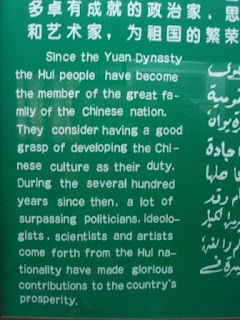 And of the many pictures chosen to represent Hui culture, my favorite was definitely this one:

 And of the many pictures chosen to represent Hui culture, my favorite was definitely this one:
Thursday, October 04, 2007
Daytrip to Inner Mongolia; or, "At the Ends of the Earth"

This week I spent exactly one day in Inner Mongolia (a northern province or more accurately "autonomous region" in China, not Mongolia the country), in a town called Bayan Hot (or 巴音 Bāyīn in Chinese). I live in a fairly remote city, but this really felt like heading out into the middle of absolute nowhere. It was a journey of close to three hours to the city, the last half of which being through pure, desolate desert with almost no signs of civilization. It's a small place that I knew little about besides it being in Inner Mongolia, the main inspiration for going.
Besides the slow pace of life and a chance to see Mongolian writing on all the signs, the town provided one of the ample opportunities to view the dichotomies and contradictions of modern China. Immediately outside the town limits, one can see the traditional clay and brick housing common in northwest China:

Mere streets away, inside the town, I was a little taken aback when I turned a corner and saw this modern monstrosity of a building:


This stadium could clearly hold the entire population of the town, and seemed a bit out of place, as well as ill-used. I asked a couple of locals and they said it was already closed for the winter but in the warmer months they hold art shows and the like. I've read that the provincial government is prone to flashy displays of development in lieu of more practical spending, and a 60,000 capacity stadium has been built in provincial capital Hohhot that with the exception of the opening celebrations is unlikely to fill up. In the near total-silence of this small town it felt a bit surreal to stand in front of it, like an apocalyptic future in which most of the population had been wiped out. Near total-silence is surreal in China anyway.
The main attraction of the town is a Mongolian temple, which was similar in style to others I've seen as many Mongolians practice Tibetan Buddhism. One monk who I guessed to be in his 30's had an obvious affinity for Westerners, and once he discovered I could speak Chinese quickly engaged me in conversation. This turned into a fast-paced and passionate 40 minute lecture about his thoughts on the society around him that fascinated me as much as it gave me a headache; he didn't pause much and I could only catch around 30% of what he said. The main idea was that he's become greatly disappointed in the loss of basic decency and morals that has accompanied fast economic growth. He thinks people in China are interested in money, success, and the approval of others at the cost of everything else. Though he said there are still decent, honest Chinese people around, the whole society is promoting economic success as the be-all and end-all of life, and it's wrong. He also is disappointed in the attitude towards Mongolians like himself; he told me they are seen as stupid, slow and uncouth by many Chinese, and they aren't truly understood. It's true that almost every time ethnic minorities come up during conversation with a Han Chinese friend they have used the word 野蛮 yěmán, which means "barbarous" or "uncivilized" and have made several disparaging remarks (generally students, who also claim during class that there is no discrimination in China). This disillusionment with society inspired him to become a monk two years ago. He hoped I would learn Mongolian and travel to Mongolia proper someday, an idea I've toyed with anyway (the traveling part at least).

I've noticed a pattern of minorities opening up to foreigners in China, whether it was Uyghurs in Xinjiang or Tibetans in Qinghai. I suppose complaints to Han Chinese would often fall on indifferent or even hostile ears (I've heard comments like "those minorities, always complaining; they have it good enough") and we provide a fresh and interested source of conversation that is outside the system. The Chinese tourists walking past us during my talk with the monk paid little attention, the only exceptions being a student who giggled and wanted to ask me where I was from, and a woman who interrupted to ask the monk if she could take pictures. I think images of Confucian scholars and Tang poetry had given me the impression of the Chinese as quite thoughtful and spiritual, which wasn't necessarily on the mark. Whatever other virtues modern Chinese society has I wouldn't put deep spirituality at the top of the list, and famous temples are pure tourist attractions with guys in their new cowboy hats taking pictures of their girlfriend while she gives the "V" sign and smiles (more on that soon).
After leaving the monk I took a bus back to Yinchuan, and on the way out saw this billboard:
After leaving the monk I took a bus back to Yinchuan, and on the way out saw this billboard:
富民是第一目标
和谐是第一任务
roughly translated:
Development is the #1 duty
Enriching the people is the #1 goal
Harmony is the #1 mission
Chinese Words and Phrases 4: 和谐社会 héxié shèhuì
Hexie shehui means "harmonious society," and is a phrase that pops up a lot in China these days. One of the current favorite government slogans, it was adopted by the Party in 2004. In the wake of such rapid growth China is experiencing well-publicized social problems including a large gap between the rich and the poor, environmental devastation, and protests by Chinese who have been forcibly moved from their land in the name of development. According to the government "a harmonious society is defined as a socialist democracy, with rule of law, social justice, honesty and credibility, balancing human activities and natural resources." If asking citizens to help build a "harmonious society" sounds vague to you, apparently the government agrees, as according to China Daily the government has recently decided to create "an index system judging social harmony." Hm. Today the terror threat in America is the color green, and the social harmony in China is around 6.4 out of 10. Another popular government campaign is the "8 Virtues and 8 Vices" or "8 Do's and Dont's," which I spied in English during my traveling:


I'm intrigued by the Party slogans, and the propaganda, much of which is perfectly well-meaning. You just don't see "Cherish Life; Give Up Drugs" painted in giant letters by the government on walls in America, or billboards encouraging you to "Carry out the Three Represents." Signs like these would be mocked to death in the West. When I first started studying Chinese I looked forward to being able to understand the signs, posters, and billboards, which are pervasive. The most common theme is probably the one-child policy, with signs reminding the populace that "Having a girl is the same as having a boy," "Carrying out the one-child policy is every citizen's duty and obligation" and "Girls are the builders of our future." I'm not sure how excited many Chinese get about getting behind the slogans anyway; for instance, Chinese bloggers who get their blogs blocked now sarcastically write about being "harmonized."
Anyway, whatever President Hu Jintao and the rest of the Party meant by Harmonious Society, I hope it wasn't this:


Tuesday, October 02, 2007
Ningxia Travels I: Capitalism Run Amok, Pyramids in China
It is time again for the National Day Holiday in China, a time for the Chinese to reflect upon the founding of their socialist republic and the myriad way it has improved their lives. And what would make the dear Chairman prouder on the anniversary of his establishment of Communist China than sales, sales, sales!


I particularly like the man in the gorilla costume, let's see a close-up of that:

As much fun as I'm having otherwise (is that a pizza buffet??) one of the main reasons to come to one of China's smallest and most obscure provinces is for a bit of history, in the form of thousand-year old pyramid-like tombs left by the Xixia kingdom. These are the centerpiece of the few remains of this fearsome and somewhat mysterious kingdom which at times rivaled the Chinese dynasties of the day, but was destined to be destroyed by Genghis Khan and the Mongols. In their heyday they controlled a sizeable piece of northwest China, including Zhangye.


I particularly like the man in the gorilla costume, let's see a close-up of that:

I've been in the city of Yinchuan for the start of the holiday and more than the pleasant museum and tranquil pagodas I can't help but notice the capitalist orgy taking place on the streets. Need a Nokia phone? A wedding dress? In the mood for audience participation, games, prizes, karaoke, or just silly dancing? The streets of a Chinese shopping district during a holiday are the place to be. Despite the sarcasm I do actually enjoy the oral assault and chaos you sometimes get in China, especially when I know I have a small, relatively sleepy city to return to. There is something to be said for the sight of adults old enough to have been through the Cultural Revolution giggling and fighting over the chance to thrown plastic rings at cell phones for a prize. Even during normal times Chinese stores know how to open or remodel in a grand way--giant inflatable archways, confetti, firecrackers, and for the really ambitious, cannons. Inevitably there is a also a mammoth stereo system playing upbeat pop or a stage with live karaoke singing.
As much fun as I'm having otherwise (is that a pizza buffet??) one of the main reasons to come to one of China's smallest and most obscure provinces is for a bit of history, in the form of thousand-year old pyramid-like tombs left by the Xixia kingdom. These are the centerpiece of the few remains of this fearsome and somewhat mysterious kingdom which at times rivaled the Chinese dynasties of the day, but was destined to be destroyed by Genghis Khan and the Mongols. In their heyday they controlled a sizeable piece of northwest China, including Zhangye.


In the end the real reason I came to Ningxia province is because no one else wants to. Traveling to and from a popular destination during a Chinese national holiday is between very difficult and a nightmare and only those with extensive experience in China can appreciate the feeling I had when I bought an overnight sleeper ticket for the train in less than four minutes. I also appreciate being simply a novelty rather than a target for harassment by vendors.
It rained heavily at the park today, and a group of us found shelter and entertainment listening to an elderly musician in a pavilion, which I probably enjoyed more than any of the ticketed attractions around town. Many curious locals have come up to talk to me and find out why I'm here; on hearing I was American one woman remarked "but aren't Americans black? Your skin is so white!" For the thousandth time a woman encouraged her shy child to "say hello to the American uncle!" and a woman suggested the violinist "play a song for our foreign friend over there." If willing conversation partners are one of the keys to learning a language, China might well be one of the best countries in the world to do it.
It rained heavily at the park today, and a group of us found shelter and entertainment listening to an elderly musician in a pavilion, which I probably enjoyed more than any of the ticketed attractions around town. Many curious locals have come up to talk to me and find out why I'm here; on hearing I was American one woman remarked "but aren't Americans black? Your skin is so white!" For the thousandth time a woman encouraged her shy child to "say hello to the American uncle!" and a woman suggested the violinist "play a song for our foreign friend over there." If willing conversation partners are one of the keys to learning a language, China might well be one of the best countries in the world to do it.
Thursday, September 27, 2007
University Life in China
As you might imagine, and as with pretty much every other facet of society, university life in China is quite different from that in a Western country. In some ways it feels more like a continuation of high school, and students are not nearly as independent and self-reliant as they are in a Western university. Ironically, the foreign teacher at this school who was least able to adapt and in fact quit a year early was the only one with a PhD and extensive university experience in America. In general the young and inexperienced teachers are successful in this environment. I've worked out a list below of some of the most obvious differences between university life at home and in China, in no particular order:
-Students are organized into classes by major, and given a class number and individual student numbers. They take all the same classes with these classmates, and have no control over their class schedule. At this school classes in the English department are around 35 students each. Some Chinese teachers call students by their numbers rather than their names.
-Changing one's major is much more complicated than in America, and involves getting permission from both departments and paying a fee. Choosing a major is also limited by your results on the college entrance exam and many of my English students would rather be studying something else. By the same token there are students with excellent English abilities in other departments who want to be English majors but can't because of exam scores.
-Each class has a class monitor, chosen by a class vote. The class monitor attends weekly meetings, passes on announcements to the class from the department, and is in charge of class activities. A student once asked me "how do you choose class monitors in America?" I explained that we don't have them, and in great confusion she asked "but who is in charge of the class?"
-Student dorm rooms typically have 5-8 students in rooms that would hold 2 in America. In this school the beds have thin straw mattresses and very little besides bunk-beds, the students' (few) possessions, and wash basins. The students do their laundry by hand, and typically wear the same two or three outfits. Males and females live in separate buildings and are not allowed to enter the opposite sex's dormitory buildings.
-Students have the same roommates for all 4 years, typically classmates that they also see in every class. It is extremely difficult to change dorm rooms and some students have falling outs with their roommates that affect the entire class atmosphere. However the drama is minimal compared to the nightmare you would get with American students in the same situation.
-Showers are in buildings separate from the dormitories and cost 3 yuan (less than 50 cents). For most students this is a significant amount and many students shower once a week.
-The school has implemented a new rule: it is mandatory for students to study in the campus classrooms from 7-9pm every night. Students who are absent and caught will be punished by having their exam grades lowered.
-Students must sign in around 7am every weekday morning, even if they don't have morning class. If they miss enough times they will be embarrassed by having their name read on the campus broadcast system. Students from families with money can and do bribe the people in charge of broadcasting and sleep in as they will.
-In English classes taught by Chinese teachers, it is typical for students to sit quietly and listen to the teacher lecture for the entire two hours, without the chance to speak a word of English. Both teachers and students (with some exceptions) will never speak English outside of class unless absolutely forced to (even with me many students want to use Chinese instead). In a three person English conversation with two Chinese and a foreigner, the two Chinese people will typically use Chinese when talking to each other. The result is that students can study English for 10 years and still be terrified of speaking to me in English. By contrast, even in high school I recall classmates using Spanish or French outside of class for the fun of it.
-Some textbooks are fine, but most leave something to be desired; there is a real textbook used at this school which has one word on the cover: "Listeing." I was able to change to a good series of reading books, but of the 40-odd stories in the first textbook I used, the most recent one was from 1971. Most were considerably older.
-Students (and Chinese people in general) are fond of performances. Campus entertainment usually takes the form of karaoke competitions and dance and music performances from students.
-With the dormitory situation, there is pretty much no privacy at all for student couples. Couples cuddle on benches or find a somewhat "secluded" spot in the grass, especially at night. I've seen what appears to be couples breaking up, simply standing off the side of a path because there is nowhere else for them to go.
-The dormitories are locked at 11:30pm, even on weekends. Two students once accompanied Andrew to a Christmas evening church service. It was so long that they missed their curfew and spent the entire night in an internet cafe, and were sick the next day.
-In order to have drinking water, students have big thermoses that they fill up in designated buildings that supply hot water. On the few occasions when the power has gone out in these buildings some students simply didn't drink anything because they didn't have money to buy water.
-Once per term each class has "duty week." This is a week when they don't go to class, instead cleaning up campus (sweeping, burning garbage) in their official school uniforms.
-Freshman have a week of military training, usually the first week of college, in which they wear uniforms, are drilled by soldiers, and do a lot of marching and shouting.
-My school has demolished the old library but not finished the new one. There is no library on campus at the moment.
-In general students don't get out as much as their Western counterparts. I once took some student friends to see Zhangye's famed "Great Buddah" statue, about a 25-minute walk away, and they were simply amazed I could get there so easily. They had never been that far away from campus before.
-There is a school broadcast system with speakers all over campus, which loudly plays news, the national anthem, and inspirational music. Broadcasts begin at 6am.
-Students stand up in unison to greet the teacher when he/she enters the room, and erase the blackboard for the teacher during breaks. Students rotate the duty of bringing the chalk and eraser to the classroom. When the student on duty forgets (which is often) I have no chalk or eraser, and someone then scrambles to get chalk from another classroom while others give me tissues to erase the board with. I've had to resort to cleaning the blackboard with a mop. I've tried hiding a cloth in the room for the times the students forget the eraser but it was soon stolen.
-Other than desks, small stools for students, the teacher's podium, the blackboard, and one electrical outlet, there is not so much as a garbage can in the classrooms. Occasionally the power is out and the outlet doesn't work, generally when I want to play music and really need power.
-Because of the crowded dorms and lack of study options, students often study outside. Because of the Chinese love of reciting out loud, this leads to the amusing sight of students reading books to trees.
-College students do drink, but not even approaching the amount that American students do. Drinking is not allowed in the dorms and due to money issues, curfews, and social norms students don't often go to bars. It is also almost exclusively males, as a Chinese female who drinks or smokes is not looked very highly upon. Working age males, however, drink much more than those in America, and it's an integral part of doing business in China. There are apparently some drugs available but I'm sure drug use is also much lower than in America (though apparently rising in the cities). Chinese drug laws are also much stiffer and include execution (incidentally China executes more people than all the other countries in the world combined).
-Pre-marital sex is considerably less common in China than the West. According to 21st Century (an English language newspaper for Chinese students), 15% of Chinese aged 18-21 have had pre-marital sex, and for the 21-24 group 39% have had pre-marital sex. The numbers are probably lower in a smaller, more conservative place like Zhangye. By contrast it claims that two-thirds of Americans under 18 have had sex. Because of living conditions it would be nearly impossible for a willing couple to have sex on campus in the first place. There is short-term off-campus housing available for students so those that are having sex often rent rooms for that purpose.
-The majority of college students have never had any kind of job before. In China a student's job is to study and they are not encouraged to earn their own money or pursue hobbies. Many of my students are getting their first part-time jobs tutoring younger students in English. Getting into a college is the result of a student's score on the college entrance exam; no other factors are considered and the pressure and preparation put into this exam are utterly unlike anything American high schoolers go through.
-It would unusual for a Chinese student to pay for college themselves. Generally they are completely funded by their parents.
-In almost every aspect of life Chinese students are less independent and self-reliant than Western students. Even with the means to do so I suspect none of my students would be willing to travel alone, even to a nearby city. Definitely not the girls. Students find it odd that I would even go out on the street by myself.
-Students seem to have little sense of note-taking, even in college. For the most part they scribble whatever I write on the board verbatim into the margins of their textbook and take no other notes. I questioned a student about her notebook and she told me "oh, I do have one, I just don't bring it to class because I'm afraid that I'll lose it."
-The student-teacher relationship is much more formal, with teacher as unquestioned master. A student was telling me a story about her middle school days. The teacher asked students to write down what they thought of her class. The student was naive enough to be honest and critical, and was asked to come to the teacher's home to be shouted at and criticized. It is also still common practice for teachers to hit students for misbehaving or performing poorly.
-Students at this school have an extremely limited knowledge of how to use computers. They have taken computer classes at the school, where they are taught a programming language that I've never heard of. I asked a student why it was useful and they said "oh we won't ever use it. But if we have this certificate it will help us get a job later." Many if not most students are unable to successfully use a search engine, send an e-mail, or get to a website when the address is already known, things which apparently are not taught in computer class. I once watched Andrew teach one of our students how to type in Chinese on a computer.
-A fairly high number of students wear glasses.
-No students own cars. Quite few teachers own cars; they are still for the wealthy. Only some students own bicycles.
-Especially in comparison to American students, Chinese students wake up early on weekends. A student once told me "sometimes we quarrel in my dormitory because I like to wake up early and do exercise with the window open on weekends, but my roommates like to sleep in late." "Late" turned out to be 8am; she preferred to get up at 6:30.
-The entire concept of education in China is different. Rote memorization is king and students are taught to copy what has come before; discussion, independent or creative thinking, unusual opinions, asking questions and certainly challenging the teacher are not encouraged. And it shows; on several occasions I've asked a student to help with some everyday task, such as sending mail to America or using a washing machine, and they were of little help because doing something unfamiliar was a bigger issue for them than the language barrier was for me.
-Foreign teachers are generally the only ones who place a heavy emphasis on the students speaking during English class; Chinese teachers sometimes deride this as "playing."
-Cheating is a much bigger problem than in the West, and is much more accepted. Students freely admit to cheating when asked. I've heard a story about a Chinese professor telling university students to "just copy from your sources. I don't want to have to correct all your English mistakes." I've had students copy straight from their textbooks (the difference is obvious) during class when all I asked them to do was do some free writing about what was on their mind, and not for a grade.
If asked to compare different aspects of American and Chinese culture, I can generally find positives and negatives of both. I didn't mean this list to be a list of complaints, but it's true that education is the one area where I can see no advantages to the Chinese way. Two of my students were shocked to come across a ranking of universities worldwide that listed Qinghua University (the best in China, which students make untold sacrifices to try to get into) at something like #180, and whispered in Chinese about how it was just a Western bias against China. Some of the problems lie with the difficulties of overpopulation (middle school classrooms typically have 60 or 70 students) and of a developing country, but some come from attitudes and ways of thinking that for the sake of Chinese students I hope eventually change. Also, I'm speaking from personal experience and not all these things would be true in all universities in China, especially if the problem is money (this is a third-tier university in one of China's poorest provinces after all). As a whole students here are not satisfied with their educational experience, and I find they usually agree with me when the conversation turns to criticizing education in China. However, I would also be interested in working in a better school in a wealthier city as a means of comparison.
When speaking Chinese with people in town, I am frequently asked if I'm studying abroad here. This first of all makes me smile, as I don't think Zhangye would be high on the list of destinations for a study abroad candidate. But it also makes me imagine life here on the other end of the classroom. I think I'll stick with being a foreign teacher.
(on a side note, for an overall excellent China read that partly deals with being an American studying abroad in China, in the early 80's no less, check out Chinese Lessons by John Pomfret)
-Students are organized into classes by major, and given a class number and individual student numbers. They take all the same classes with these classmates, and have no control over their class schedule. At this school classes in the English department are around 35 students each. Some Chinese teachers call students by their numbers rather than their names.
-Changing one's major is much more complicated than in America, and involves getting permission from both departments and paying a fee. Choosing a major is also limited by your results on the college entrance exam and many of my English students would rather be studying something else. By the same token there are students with excellent English abilities in other departments who want to be English majors but can't because of exam scores.
-Each class has a class monitor, chosen by a class vote. The class monitor attends weekly meetings, passes on announcements to the class from the department, and is in charge of class activities. A student once asked me "how do you choose class monitors in America?" I explained that we don't have them, and in great confusion she asked "but who is in charge of the class?"
-Student dorm rooms typically have 5-8 students in rooms that would hold 2 in America. In this school the beds have thin straw mattresses and very little besides bunk-beds, the students' (few) possessions, and wash basins. The students do their laundry by hand, and typically wear the same two or three outfits. Males and females live in separate buildings and are not allowed to enter the opposite sex's dormitory buildings.
-Students have the same roommates for all 4 years, typically classmates that they also see in every class. It is extremely difficult to change dorm rooms and some students have falling outs with their roommates that affect the entire class atmosphere. However the drama is minimal compared to the nightmare you would get with American students in the same situation.
-Showers are in buildings separate from the dormitories and cost 3 yuan (less than 50 cents). For most students this is a significant amount and many students shower once a week.
-The school has implemented a new rule: it is mandatory for students to study in the campus classrooms from 7-9pm every night. Students who are absent and caught will be punished by having their exam grades lowered.
-Students must sign in around 7am every weekday morning, even if they don't have morning class. If they miss enough times they will be embarrassed by having their name read on the campus broadcast system. Students from families with money can and do bribe the people in charge of broadcasting and sleep in as they will.
-In English classes taught by Chinese teachers, it is typical for students to sit quietly and listen to the teacher lecture for the entire two hours, without the chance to speak a word of English. Both teachers and students (with some exceptions) will never speak English outside of class unless absolutely forced to (even with me many students want to use Chinese instead). In a three person English conversation with two Chinese and a foreigner, the two Chinese people will typically use Chinese when talking to each other. The result is that students can study English for 10 years and still be terrified of speaking to me in English. By contrast, even in high school I recall classmates using Spanish or French outside of class for the fun of it.
-Some textbooks are fine, but most leave something to be desired; there is a real textbook used at this school which has one word on the cover: "Listeing." I was able to change to a good series of reading books, but of the 40-odd stories in the first textbook I used, the most recent one was from 1971. Most were considerably older.
-Students (and Chinese people in general) are fond of performances. Campus entertainment usually takes the form of karaoke competitions and dance and music performances from students.
-With the dormitory situation, there is pretty much no privacy at all for student couples. Couples cuddle on benches or find a somewhat "secluded" spot in the grass, especially at night. I've seen what appears to be couples breaking up, simply standing off the side of a path because there is nowhere else for them to go.
-The dormitories are locked at 11:30pm, even on weekends. Two students once accompanied Andrew to a Christmas evening church service. It was so long that they missed their curfew and spent the entire night in an internet cafe, and were sick the next day.
-In order to have drinking water, students have big thermoses that they fill up in designated buildings that supply hot water. On the few occasions when the power has gone out in these buildings some students simply didn't drink anything because they didn't have money to buy water.
-Once per term each class has "duty week." This is a week when they don't go to class, instead cleaning up campus (sweeping, burning garbage) in their official school uniforms.
-Freshman have a week of military training, usually the first week of college, in which they wear uniforms, are drilled by soldiers, and do a lot of marching and shouting.
-My school has demolished the old library but not finished the new one. There is no library on campus at the moment.
-In general students don't get out as much as their Western counterparts. I once took some student friends to see Zhangye's famed "Great Buddah" statue, about a 25-minute walk away, and they were simply amazed I could get there so easily. They had never been that far away from campus before.
-There is a school broadcast system with speakers all over campus, which loudly plays news, the national anthem, and inspirational music. Broadcasts begin at 6am.
-Students stand up in unison to greet the teacher when he/she enters the room, and erase the blackboard for the teacher during breaks. Students rotate the duty of bringing the chalk and eraser to the classroom. When the student on duty forgets (which is often) I have no chalk or eraser, and someone then scrambles to get chalk from another classroom while others give me tissues to erase the board with. I've had to resort to cleaning the blackboard with a mop. I've tried hiding a cloth in the room for the times the students forget the eraser but it was soon stolen.
-Other than desks, small stools for students, the teacher's podium, the blackboard, and one electrical outlet, there is not so much as a garbage can in the classrooms. Occasionally the power is out and the outlet doesn't work, generally when I want to play music and really need power.
-Because of the crowded dorms and lack of study options, students often study outside. Because of the Chinese love of reciting out loud, this leads to the amusing sight of students reading books to trees.
-College students do drink, but not even approaching the amount that American students do. Drinking is not allowed in the dorms and due to money issues, curfews, and social norms students don't often go to bars. It is also almost exclusively males, as a Chinese female who drinks or smokes is not looked very highly upon. Working age males, however, drink much more than those in America, and it's an integral part of doing business in China. There are apparently some drugs available but I'm sure drug use is also much lower than in America (though apparently rising in the cities). Chinese drug laws are also much stiffer and include execution (incidentally China executes more people than all the other countries in the world combined).
-Pre-marital sex is considerably less common in China than the West. According to 21st Century (an English language newspaper for Chinese students), 15% of Chinese aged 18-21 have had pre-marital sex, and for the 21-24 group 39% have had pre-marital sex. The numbers are probably lower in a smaller, more conservative place like Zhangye. By contrast it claims that two-thirds of Americans under 18 have had sex. Because of living conditions it would be nearly impossible for a willing couple to have sex on campus in the first place. There is short-term off-campus housing available for students so those that are having sex often rent rooms for that purpose.
-The majority of college students have never had any kind of job before. In China a student's job is to study and they are not encouraged to earn their own money or pursue hobbies. Many of my students are getting their first part-time jobs tutoring younger students in English. Getting into a college is the result of a student's score on the college entrance exam; no other factors are considered and the pressure and preparation put into this exam are utterly unlike anything American high schoolers go through.
-It would unusual for a Chinese student to pay for college themselves. Generally they are completely funded by their parents.
-In almost every aspect of life Chinese students are less independent and self-reliant than Western students. Even with the means to do so I suspect none of my students would be willing to travel alone, even to a nearby city. Definitely not the girls. Students find it odd that I would even go out on the street by myself.
-Students seem to have little sense of note-taking, even in college. For the most part they scribble whatever I write on the board verbatim into the margins of their textbook and take no other notes. I questioned a student about her notebook and she told me "oh, I do have one, I just don't bring it to class because I'm afraid that I'll lose it."
-The student-teacher relationship is much more formal, with teacher as unquestioned master. A student was telling me a story about her middle school days. The teacher asked students to write down what they thought of her class. The student was naive enough to be honest and critical, and was asked to come to the teacher's home to be shouted at and criticized. It is also still common practice for teachers to hit students for misbehaving or performing poorly.
-Students at this school have an extremely limited knowledge of how to use computers. They have taken computer classes at the school, where they are taught a programming language that I've never heard of. I asked a student why it was useful and they said "oh we won't ever use it. But if we have this certificate it will help us get a job later." Many if not most students are unable to successfully use a search engine, send an e-mail, or get to a website when the address is already known, things which apparently are not taught in computer class. I once watched Andrew teach one of our students how to type in Chinese on a computer.
-A fairly high number of students wear glasses.
-No students own cars. Quite few teachers own cars; they are still for the wealthy. Only some students own bicycles.
-Especially in comparison to American students, Chinese students wake up early on weekends. A student once told me "sometimes we quarrel in my dormitory because I like to wake up early and do exercise with the window open on weekends, but my roommates like to sleep in late." "Late" turned out to be 8am; she preferred to get up at 6:30.
-The entire concept of education in China is different. Rote memorization is king and students are taught to copy what has come before; discussion, independent or creative thinking, unusual opinions, asking questions and certainly challenging the teacher are not encouraged. And it shows; on several occasions I've asked a student to help with some everyday task, such as sending mail to America or using a washing machine, and they were of little help because doing something unfamiliar was a bigger issue for them than the language barrier was for me.
-Foreign teachers are generally the only ones who place a heavy emphasis on the students speaking during English class; Chinese teachers sometimes deride this as "playing."
-Cheating is a much bigger problem than in the West, and is much more accepted. Students freely admit to cheating when asked. I've heard a story about a Chinese professor telling university students to "just copy from your sources. I don't want to have to correct all your English mistakes." I've had students copy straight from their textbooks (the difference is obvious) during class when all I asked them to do was do some free writing about what was on their mind, and not for a grade.
If asked to compare different aspects of American and Chinese culture, I can generally find positives and negatives of both. I didn't mean this list to be a list of complaints, but it's true that education is the one area where I can see no advantages to the Chinese way. Two of my students were shocked to come across a ranking of universities worldwide that listed Qinghua University (the best in China, which students make untold sacrifices to try to get into) at something like #180, and whispered in Chinese about how it was just a Western bias against China. Some of the problems lie with the difficulties of overpopulation (middle school classrooms typically have 60 or 70 students) and of a developing country, but some come from attitudes and ways of thinking that for the sake of Chinese students I hope eventually change. Also, I'm speaking from personal experience and not all these things would be true in all universities in China, especially if the problem is money (this is a third-tier university in one of China's poorest provinces after all). As a whole students here are not satisfied with their educational experience, and I find they usually agree with me when the conversation turns to criticizing education in China. However, I would also be interested in working in a better school in a wealthier city as a means of comparison.
When speaking Chinese with people in town, I am frequently asked if I'm studying abroad here. This first of all makes me smile, as I don't think Zhangye would be high on the list of destinations for a study abroad candidate. But it also makes me imagine life here on the other end of the classroom. I think I'll stick with being a foreign teacher.
(on a side note, for an overall excellent China read that partly deals with being an American studying abroad in China, in the early 80's no less, check out Chinese Lessons by John Pomfret)
Subscribe to:
Posts (Atom)